Mahama reveals Ghana’s small-scale gold sector generated $10.8bn after GoldBod reforms
President John Dramani Mahama has revealed that Ghana’s artisanal and small-scale mining sector generated $10.8 billion in revenue following the introduction of reforms requiring all gold produced by the sector to be channelled through the Ghana Gold Board (GoldBod).
He said the reforms had significantly improved the country’s ability to capture value from its gold resources, strengthen oversight of the sector and ensure that more mineral wealth remained within the Ghanaian economy.
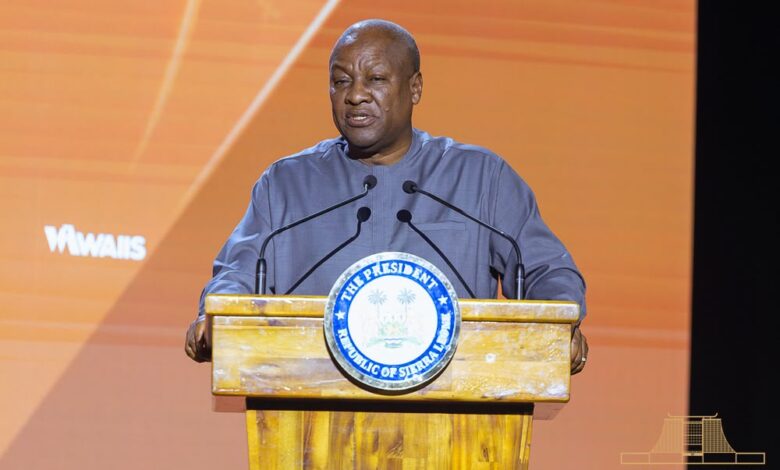
President Mahama made the disclosure while addressing the West Africa Integration and Investment Summit (WAIIS) in Sierra Leone, where he called on African countries to exercise greater control over their natural resources and ensure that mineral wealth translates into economic prosperity for their citizens.
He explained that before the introduction of the Gold Board reforms, artisanal and small-scale mined gold was being exported through various channels, limiting the country’s ability to fully benefit from the proceeds.
“In 2024, we had a situation where artisanal and small-scale mined gold was taken out freely by all kinds of people,” he said.
He noted that his government subsequently changed the law to require all gold from the artisanal and small-scale mining sector to pass through the Gold Board before it could be exported.
“We changed the law and said you cannot take any gold out of Ghana without it going through the Gold Board. The penalty is the gold will be confiscated and then you also go to prison,” President Mahama stated.
According to him, the results of the policy were reflected in the significant increase in gold production and the value generated from the small-scale mining sector.
He disclosed that the sector produced 64 tonnes of gold in 2024, generating a total value of $4.6 billion before the reforms.
However, following the introduction of the Ghana Gold Board law, production increased to 104 tonnes, with the sector generating $10.8 billion for the Ghanaian economy.
“So, in 2024, the artisanal and small-scale mining sector produced 64 tons of gold and a total value of $4.6 billion. After we introduced the Ghana Gold Board law, the small-scale artisanal sector produced 104 tons of gold and brought in $10.8 billion into the Ghanaian economy,” he said.
President Mahama described the development as an example of how African countries could maximise the benefits of their natural resources through effective regulation and stronger national control over mineral exports.
He argued that the continent could no longer afford to allow its mineral wealth to generate prosperity primarily for foreign interests while communities surrounding mining operations continued to experience poverty.
“It is an issue of exercising sovereignty over what God blessed us with. We did not put the gold there, God gave it to us. The diamonds, God gave it to us. And our people must benefit from that,” he stressed.
The President further called for a review of mineral agreements that, in his view, had historically limited the revenue African countries received from large-scale mining operations.
He cited Ghana’s decision to introduce a sliding-scale royalty regime for large-scale gold mining companies, replacing arrangements that had locked royalties at three per cent.
Under the revised framework, he said, royalties could increase from a minimum of five per cent to 12 per cent depending on prevailing gold prices.
“Let us change to a sliding scale, so if the price comes down, we will come to the minimum royalty, 5%. If it goes up like gold has done, we’ll charge you 12%,” he explained.
President Mahama disclosed that since the law was passed, large-scale gold mining companies had paid GH¢7.8 billion in royalties under the revised arrangement.
He maintained that African governments must reassess their mineral agreements and strengthen policies that ensure natural resources contribute meaningfully to national development, job creation and improved livelihoods.
“African minerals must be a source of wealth and prosperity for African people,” he declared.