Ghana can earn four to five times more from processed cashew – GEXIM CEO
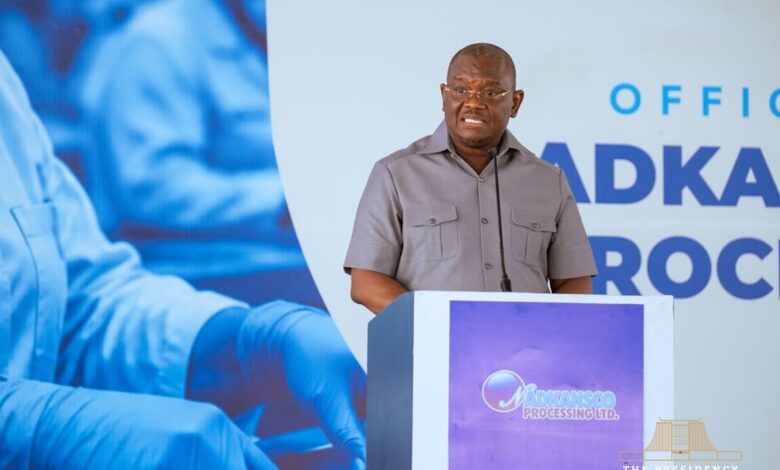
The Chief Executive Officer of the Ghana Export-Import Bank (GEXIM), Hon. Sylvester Adinam Mensah, has said Ghana stands to earn significantly higher revenue from cashew exports by processing the nuts locally rather than exporting them in their raw state.
He said processed cashew kernels could fetch prices approximately four to five times higher than raw cashew nuts, highlighting the economic benefits of expanding local processing capacity and retaining more value within the country.
Speaking at the commissioning of the Nadkansco Cashew Processing Factory at Tuobodom in the Techiman North District of the Bono East Region by President John Dramani Mahama, Mr Mensah stressed the need for Ghana to move beyond the export of raw agricultural produce and invest more in value addition.
“Per tonne, kernel sells for roughly four to five times the price of raw cashew nuts. In other words, a tonne of raw nuts yields only 20 to 25 per cent of kernels,” he explained.
He said the development of large-scale cashew processing facilities would enable Ghana to capture more economic benefits from its cashew industry, including increased export earnings, job creation and industrial growth.
According to him, Ghana produced more than 262,000 metric tonnes of raw cashew nuts last year, but only about 17,000 metric tonnes were processed locally, with the remainder leaving the country as raw nuts.
“The rest left our shores as raw nuts, and with them went the jobs, the skills and the value,” he lamented.
Mr Mensah said the Nadkansco factory represented a major step towards reversing the trend, with an installed capacity to process up to 33,000 metric tonnes of raw cashew annually.
He noted that the facility alone had the potential to process almost twice the volume of cashew nuts processed across the entire country last year.
The GEXIM CEO disclosed that the bank had committed approximately $12 million to support the project, covering automated processing equipment, working capital and training for the workforce.
He explained that more than $3 million had been invested in state-of-the-art automated equipment, while over GH¢110 million had been provided as working capital to support the purchase of raw cashew nuts.
Mr Mensah said the factory was already employing close to 1,000 people directly and supporting another 3,000 indirectly through farming, transportation, aggregation, packaging and other activities along the value chain.
“This is 4,000 livelihoods sustained in one decision to process here at home instead of shipping raw nuts abroad,” he stated.
He added that the factory’s operations aligned with the government’s 24-hour economy agenda by promoting multiple production shifts, maximising industrial capacity and creating additional employment opportunities.
Mr Mensah further disclosed that the company was preparing to produce various grades of cashew kernels, cashew nut shell liquid and other by-products for international markets, while supplying roasted kernels, cashew cake and briquettes to the local market.
He urged the management of Nadkansco to increase production and operate at full capacity to maximise the economic benefits of the investment.
“My appeal to the management of Nadkansco is simple: scale up and go to full capacity,” he said.
He assured the company of GEXIM’s continued financial backing, explaining that the bank had committed affordable, patient financing over three cashew seasons to ensure the sustainability of the business.
“We are not here to write a cheque and walk away. We are here for the long haul,” he emphasised.
Mr Mensah said expanding local cashew processing would help Ghana retain more of the wealth generated from its agricultural resources while strengthening the country’s export competitiveness and creating sustainable jobs.
He called for continued collaboration among government, financial institutions, cashew farmers, traditional authorities and local communities to ensure the long-term success of the factory and other investments in the agricultural value chain.