Mahama urges Labour Commission to resolve workplace disputes without delay

President John Dramani Mahama has urged the newly sworn-in National Labour Commission (NLC) to ensure the prompt and impartial resolution of workplace disputes, stressing that delays in addressing grievances could undermine industrial harmony and public confidence in Ghana’s labour dispute resolution system.
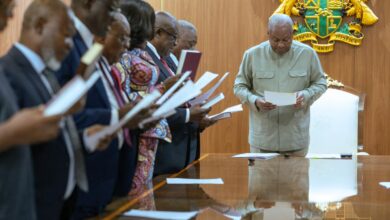
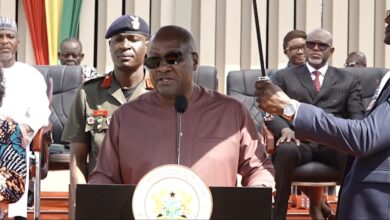
Speaking at the swearing-in ceremony of the seven-member Commission at Jubilee House, President Mahama charged the new leadership to prioritise fairness, consistency and effective mediation in handling disputes between employers and workers.
He said the Commission must create an environment where workers and employers are confident that their concerns will receive a fair hearing and be addressed without unnecessary delays.
“A worker with a grievance wants to know that somebody will hear it and deal with it fairly and expeditiously. An employer wants to know that the rules are clear and will be applied consistently. The National Labour Commission has a responsibility to do both,” he stated.
President Mahama emphasised that early intervention was necessary to prevent disagreements in workplaces from escalating into major industrial disputes.
He therefore urged the Commission to bring disputing parties together promptly and make effective use of mediation to find amicable solutions.
“Where a dispute is taking shape, bring the parties together promptly and make full use of mediation. When a case requires a decision, hear each side fairly, patiently, and give clear reasons and deal with it without undue delay,” he charged.
The President said the Commission’s ability to deliver timely and impartial decisions would be critical to maintaining stable working relationships and protecting the interests of both employers and employees.
He further called on public institutions to take workplace grievances seriously and use established mechanisms to address them.
“Industrial peace grows when people see that their concerns receive a fair hearing, and that agreements are respected,” he said.
Mahama calls for greater awareness of labour rights
President Mahama also highlighted the importance of public education, urging the Commission to intensify efforts to educate workers and employers on their rights and responsibilities under the Labour Act, 2003 (Act 651).
He said young workers must be aware of where to seek assistance when workplace grievances remain unresolved, while small business owners must understand their obligations when employing people.
The President further noted that the ongoing review of the Labour Act must address emerging challenges in the world of work, particularly the growing number of people earning their livelihoods through digital platforms.
Using delivery riders as an example, he said workers engaged through mobile applications must have clear channels to seek redress when payment disputes arise or access to their platforms is suspended.
“Think of a delivery rider who receives work through an app. If a payment is disputed or access to the app is suspended, the rider needs to know whom to contact and how to get a fair hearing. These are practical questions that our review of the Labour Act must address,” he noted.
He encouraged organised labour, employers, digital platform operators and platform workers to participate in consultations on the proposed amendments to the Labour Act.
Justice Duose leads seven-member Commission
The National Labour Commission is chaired by Justice Isaac Delali Duose, a retired Justice of the Court of Appeal.
The other members are Mr Joseph Kingsley Amuah and Mr Isaac Sackey, representing the Ghana Employers Association; Mr Prince William Ankrah and Mr Abdul-Samad Ali Gomdah, representing Organised Labour; and Madam Rosemond Freeman-Tettey and Mr Antwi-Boasiako Sekyere, presidential nominees.
The newly appointed Chairperson and members expressed appreciation to President Mahama for the confidence reposed in them and pledged to discharge their responsibilities with transparency, fairness and impartiality.
The Commission is mandated to help prevent and resolve industrial disputes, investigate unfair labour practices and promote constructive engagement between employers and workers.
Its performance is expected to play an important role in strengthening industrial relations and rebuilding public confidence in Ghana’s labour dispute resolution system.