Historical injustices against Africa remain embedded in global power structures – President Mahama
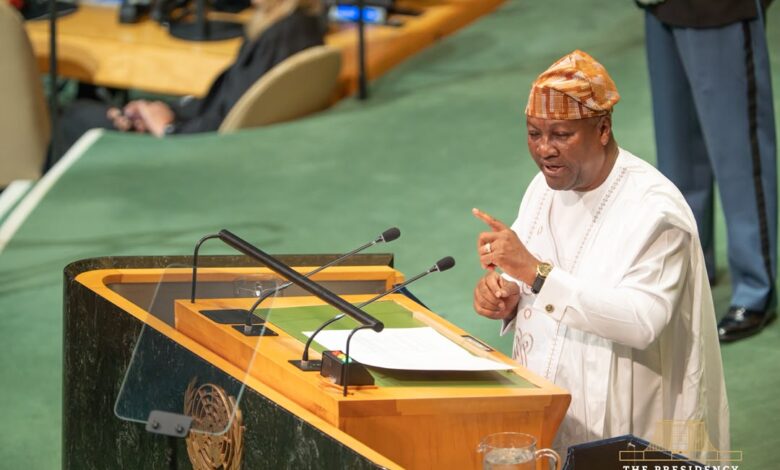
President John Dramani Mahama has argued that the historical injustices suffered by Africa continue to shape contemporary global power structures, calling for deeper reforms to address inequalities in international trade, finance and resource exploitation.
Addressing the 81st United Nations General Assembly in New York, President Mahama said the legacy of the transatlantic slave trade and racialised chattel enslavement of Africans extends beyond the historical period and remains relevant to present-day global economic relations.
He said the recognition of those historical crimes must be accompanied by meaningful measures to address their continuing structural consequences.
“Real repair demands structural transformation,” President Mahama said.
According to him, this requires confronting what he described as persistent forms of exploitation, including unfair global trade arrangements, resource extraction, discriminatory credit ratings, unsustainable debt burdens and the continued export of raw materials from Africa while higher-value processing and job creation take place elsewhere.
“The injustices of the past remain embedded in today’s power structures,” he declared.
President Mahama recalled Ghana’s role in tabling a resolution at the United Nations on the transatlantic slave trade and chattel enslavement, saying the resolution sought international recognition of the historical crimes and their enduring consequences.
He said the resolution was adopted after 123 countries voted in favour, describing the outcome as an important step in the international discussion on historical justice.
President Mahama expressed appreciation to countries and regional groupings that supported the initiative, including partners in the African Union, the Caribbean Community and Latin American and Caribbean countries.
He also welcomed what he described as positive moves by countries including the Netherlands, Germany and France to engage in discussions on reparatory justice.
The President, however, stressed that reparatory justice should not be limited to symbolic acknowledgement.
He argued that meaningful repair must address structural economic conditions that continue to affect developing countries, particularly those in Africa and the wider Global South.
President Mahama linked the issue to Africa’s continued exclusion from permanent membership of the UN Security Council, describing the absence as inconsistent with the principle of sovereign equality among nations.
He called for Africa to be granted permanent representation on the Security Council, with the full rights and responsibilities attached to such membership.
The President also called for reforms to the international financial architecture to provide developing countries with more affordable and accessible financing for industrialisation, human development and climate adaptation.
He said Africa was not seeking charity but equal partnership based on mutual respect.
President Mahama further urged African countries to strengthen accountability and transparency at home while pursuing reforms internationally.
He said African leadership must ensure that the continent’s resources are managed efficiently and that economic development delivers tangible benefits to its people.
The President’s address placed historical justice within a broader call for a more inclusive international system in which Africa has greater representation, economic opportunities and control over the value generated from its natural resources.