Africa must be granted permanent representation on the UN Security Council- President Mahama
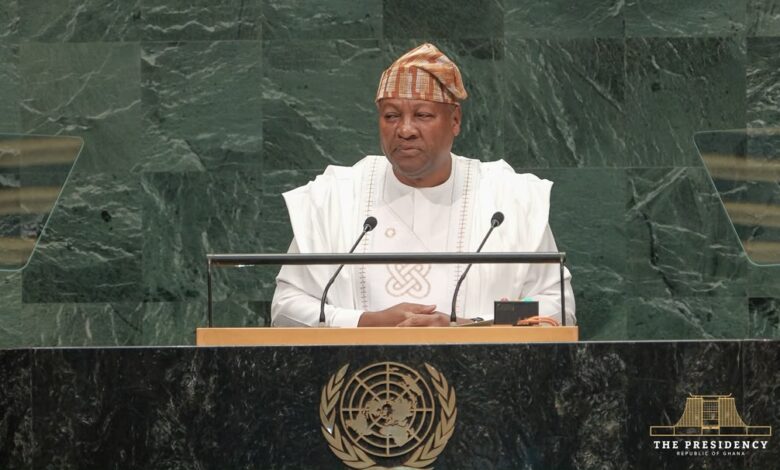
President John Dramani Mahama has renewed calls for Africa to be granted permanent representation on the United Nations Security Council, arguing that the continent’s continued exclusion from the permanent membership structure undermines the principle of sovereign equality among nations.
Addressing the 81st United Nations General Assembly in New York, President Mahama said Africa, with its large and growing population and status as the largest regional voting bloc in the General Assembly, could no longer remain without a permanent seat on the Security Council.
“Africa must be granted permanent representation on the UN Security Council, complete with all the rights and responsibilities,” he said.
President Mahama described the absence of permanent African representation as fundamentally inconsistent with the realities of the 21st century.
He argued that the current structure of the Security Council reflects geopolitical conditions that existed at the end of the Second World War and does not adequately represent the contemporary international system.
“We cannot credibly champion the sovereign equality of nations while preserving a global governance structure that was designed for the post-war geopolitical realities,” he said.
The President stressed that reform of the Security Council should not be viewed as a concession to Africa but as part of efforts to strengthen the legitimacy and credibility of the United Nations.
“Security Council reform is not a favour to Africa; it is an imperative for the legitimacy, the credibility, and the survival of the United Nations,” President Mahama declared.
He said Africa’s demand for permanent representation was connected to broader concerns about historical and contemporary inequalities in global governance.
According to President Mahama, the continent has contributed significantly to the global economy and remains central to discussions on peace and security, climate change, migration, development and natural resources.
He also called for reforms to the wider international financial architecture, noting that developing countries face significantly higher borrowing costs and often have to contend with debt pressures that constrain their ability to invest in development.
President Mahama advocated long-term, affordable and accessible concessional financing to help developing countries strengthen human capital, industrialise their economies and adapt to climate change.
He maintained that Africa was seeking equal partnership in global affairs rather than charity.
The President’s call for Security Council reform formed part of a broader appeal for a more inclusive multilateral system capable of reflecting contemporary geopolitical and demographic realities.
He urged the international community to address the structural inequalities within global institutions and ensure that Africa has an effective voice in decisions that affect international peace, security and development.