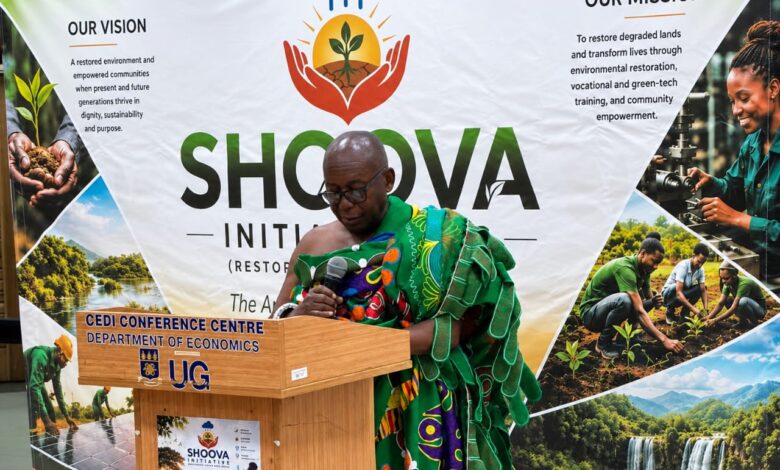
The SHOOVA Initiative, a new Ghanaian not-for-profit organization, was officially launched in Accra on Friday, August 28, 2026, with a call to restore degraded lands and empower Ghana’s youth.
The launch ceremony was held at the Cedi Conference Centre, University of Ghana, Legon, and brought together representatives from government agencies, non-governmental organizations, traditional authorities, educational institutions, development partners and the private sector.
The occasion was chaired by Baafuo Adu-Yeboah, Adwareasehene of the Dormaa Traditional Council, who presided over the ceremony and joined other distinguished guests in highlighting the importance of restoring Ghana’s degraded lands while creating meaningful opportunities for young people.
The Initiative was founded by William Odame Agyekum, President and Founder of SHOOVA Initiative, who established the organization in response to the growing impact of irresponsible mining, youth unemployment and other developmental challenges confronting communities across Ghana.
Addressing attendees, Executive Secretary Rev. Opong-Yeboah said the organization was established to respond to the twin challenges of irresponsible mining and youth unemployment, as well as the broader developmental challenges confronting communities across the country.
According to the organization, its mission is to ignite a restoration movement in Ghana by empowering the next generation of technical leaders with world-class skills, ethical grounding and environmental stewardship necessary to heal the land and reclaim the future.
The Initiative envisions a Ghana where communities once scarred by irresponsible mining are transformed into centres of environmental renewal, technical excellence, sustainable enterprise and dignified opportunities.
The Board and Management of SHOOVA said its approach went beyond enforcement and reclamation, focusing instead on deliberate investment in people, skills, responsible citizenship, sustainable enterprise and community transformation.
The organization said it believed that lasting environmental restoration could not be achieved without restoring the people and communities whose lives and livelihoods were affected by environmental degradation.