The New Patriotic Party (NPP) has accused the government of achieving its 2025 fiscal surplus through expenditure compression and delayed projects rather than genuine revenue growth, ahead of Thursday’s 2026 Mid-Year Budget Review.
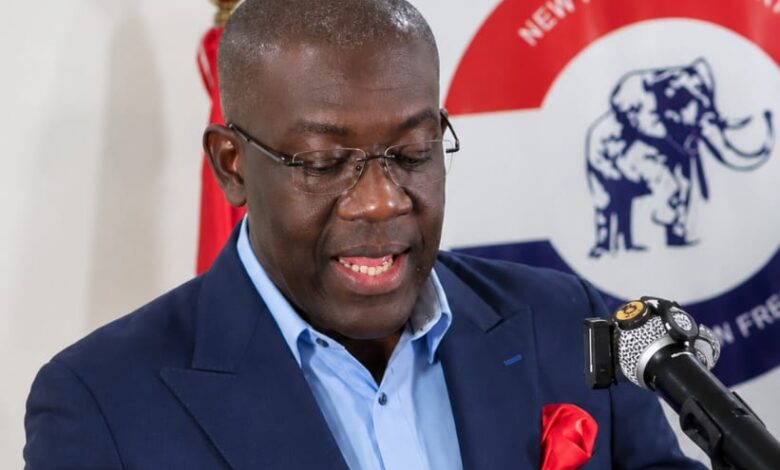
Addressing the press on Wednesday, Chairman of the NPP Policy Coordination Committee on Finance and Economy, Kojo Oppong Nkrumah (MP), said the party’s review of government data raises “key worrying signals” about the durability of Ghana’s economic gains.
“How the Surplus Was Made”: Expenditure Cuts, Not Revenue Overperformance
Mr. Oppong Nkrumah said the government is expected to tout a 2025 primary surplus of 2.6% of GDP against a target of 1.5%. However, he argued the numbers were “manufactured” through spending cuts.
“Look underneath. Revenue missed the revised target by 4.7 percent. The surplus was delivered because expenditure was compressed by 13.8 percent,” he stated.
Citing Bank of Ghana data for Q1 2026, he said the pattern continued: spending was GHC62.1 billion against a target of GHC78.8 billion — 21.2% below target. Capital expenditure was 41.9% below target, foreign-financed projects executed only GHC0.6 billion out of GHC5.3 billion, and grants to health, education and districts were 19.1% below.
“The one protected line? The wage bill,” he said, describing it as “the weakest first-quarter execution since 2017” with about GHC24 billion unexecuted in three months. “Roads, schools and hospitals carried the cut. The payroll did not.”
Durability in Doubt: Gold, IMF, and a Slipping Cedi
The NPP raised four tests of durability.
First, the party noted the IMF Executive Board is expected to approve a final ECF review and a new Policy Coordination Instrument on July 27. Mr. Oppong Nkrumah said choosing a non-financing PCI “is an admission that an external anchor is still needed” and pointed to IMF warnings on SOEs, contingent liabilities and gold-price reliance.
Second, he said the much-touted 6.4% Q1 growth was driven by gold, not policy. “Industry’s growth rate jumped from 1.9 to 6.9 percent in one quarter on the back of gold mining, and export earnings hit a record 31.1 billion dollars in 2025 on historically high gold prices.” He asked the Minister to publish sensitivity analysis: “If gold returned to its five-year average price, what would growth be?”
Third, on inflation and currency, he noted headline inflation has risen for three straight months to 5.3% in June, driven by fuel costs, while the cedi has depreciated between 8.4% and 10.3% this year. He warned that last year’s debt-to-GDP improvement partly came from exchange-rate valuation, “and what the currency gave, the currency can take back.”
Fourth, he flagged conflicting debt figures. “The Bank of Ghana reports debt at roughly 45.1 percent of GDP as at May 2026. The IMF projects 53 percent by the end of this year.” With the IMF program targeting 55% by 2028, he said “the increased borrowing we are seeing so early means this target is already at risk.”
Arrears, Revenue Shortfalls and the Bank of Ghana “Time Bomb”
On arrears, the NPP said the Finance Minister reported GHC67.5 billion inherited arrears, with a joint audit validating GHC45.4 billion. Yet only GHC13 billion was allocated in the 2025 budget and the Minister now says only GHC11.5 billion has been cleared. “So what is the true arrears stock today?” he asked.
Revenue is also faltering, the party said. Q1 revenue missed the program by 4.5% and oil revenue dropped from about GHC19.8 billion in 2024 to GHC8.7 billion in 2025. “Does the GHC268.1 billion full-year target still stand? If so, from where will the gap be closed, without new distortionary taxes?”
The statement devoted significant attention to the Bank of Ghana. It cited a 2025 loss of GHC15.63 billion reported by the Bank, but said the Minority’s analysis puts the full loss at GHC44.5 billion, with independent analysis estimating negative equity at about GHC96 billion, or 8% of GDP. The IMF, he said, has named the Domestic Gold Purchase Programme as a driver.
Mr. Oppong Nkrumah also referenced the Governor’s announcement on Monday that the Bank has ceased pre-financing GoldBod’s gold purchases effective July 1. “For months, the Minority warned that this financing was an unbudgeted, quasi-fiscal operation… We were dismissed. Then the IMF quantified it: roughly 214 million dollars lost… Now, quietly, without apology, the Bank has stopped the financing. It is too little, and it is too late.”
Credibility Test: Announcements vs Cash Releases
In “Part Three”, the NPP questioned credibility. It alleged a gap between announcements and actual releases: Finance said over GHC1.6 billion was released to Agriculture in June, but Agriculture officials put disbursement near GHC453 million. It also cited RTI data suggesting 76-90% of Big Push road contracts worth over GHC70 billion were sole-sourced.
On jobs, the party said the 24-Hour Economy’s 1.7 million jobs target has a direct 2026 allocation of only GHC110 million, and the 160,000 jobs announced are tied to MoUs, “not operating projects.” It also flagged unpaid cocoa farmers despite a February producer price announcement.
The NPP further said nearly two years on, about $2.7 billion of eligible debt — 2% — remains unresolved, and asked about the status of the promised independent Fiscal Council and Debt Management Office.
Eight Things the Minister Must Disclose on Thursday
The party listed eight disclosures it expects in the Review:
1. Actual half-year execution by line item
2. Full decomposition of the primary surplus
3. One reconciled debt-to-GDP figure and methodology
4. Current audited arrears stock with payment schedule
5. Verified payroll employment for Big Push and 24-Hour Economy
6. The true loss figure and resolution plan for Bank of Ghana
7. Sensitivity analysis on gold prices, fuel and cedi
8. Status of Fiscal Council and financing plan for growth agenda
“A country cannot build growth on unspent budgets, unpaid contractors, disputed debt numbers and jobs that exist on paper,” Mr. Oppong Nkrumah said. “Ghanaians deserve numbers, not narrative.”
The NPP said its finance team, including Dr. Mohammed Amin Adam, Dr. Gideon Boako and Dr. Kabiru Tia Mahama, will be in Parliament on Thursday to scrutinize the Minister’s statement “line by line against his government’s own published data.”