Monetisation of politics threatening democracy – Bagbin warns growing Influence of money is undermining democracy
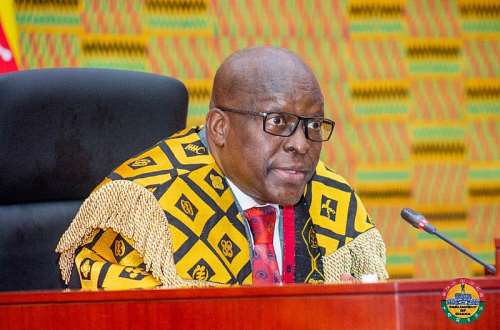
Speaker of Parliament Alban Sumana Kingsford Bagbin has expressed concern over the increasing role of money in politics, warning that it is gradually excluding ordinary citizens from governance and transforming public office into a financial investment rather than a platform for public service.
According to him, the rising cost of political participation is eroding democratic values, weakening public confidence in political institutions and creating an environment where financial resources, rather than competence, ideas and dedication to national development, determine electoral success.
“When money becomes the main determinant of political success, democracy becomes increasingly inaccessible to ordinary citizens,” Mr Bagbin said. “Public office is no longer viewed as a public trust but as an investment to be recovered, while political competition shifts from a contest of ideas and service to one driven by financial power.”
He made the remarks during the opening of the three-day High-Level Regional Convening on the Financialisation of Politics in Africa, currently taking place in Accra.
The forum has brought together senior government officials, anti-corruption agencies, electoral management bodies, civil society organisations, researchers, development partners and governance experts to examine the growing influence of money in politics across Africa and identify practical reforms to address the challenge.
The event is jointly organised by the African Union Advisory Board Against Corruption, the Community of Practice on Political Finance in Africa, the Ghana Centre for Democratic Development (CDD-Ghana), Open Society Foundations and Transparency International Ghana.
The conference aims to raise awareness of the impact of political financing on democratic governance while promoting policy reforms based on research and evidence.
Democracy under pressure
Mr Bagbin stressed that the issue extends beyond Ghana and Africa, describing the financialisation of politics as a global threat to democracy.
“Across Africa and indeed around the world, democracy is facing increasing pressure. In many respects, democratic governance is experiencing a decline,” he said.
He identified declining public trust, illicit financial flows, opaque campaign financing, state capture and the growing commercialisation of political competition as major threats undermining democratic institutions.
“Ultimately, citizens lose confidence in democratic institutions and become disengaged from the political process,” he noted.
Rising cost of politics
Reflecting on his own political journey since entering Parliament in 1992, Mr Bagbin said the financial demands of elections have grown considerably over the years.
He recalled funding much of his first election campaign from his personal savings before later relying on financial support from his wife when his own resources were exhausted.
“That was the cost of deciding to serve my people,” he said.
The Speaker also noted that political financing goes beyond campaign expenditure, explaining that elected officials are often expected to provide financial assistance to constituents and support community activities.
“You cannot visit traditional leaders empty-handed. Likewise, when you return to your constituency, people expect you to contribute towards education, healthcare and the welfare of the less privileged. Otherwise, they believe you have abandoned them,” he explained.
Despite these challenges, Mr Bagbin rejected the notion that politics itself is inherently corrupt, arguing instead that unethical behaviour by individuals is the real problem.
“Politics is not a dirty game. It is the people who engage in politics without integrity that make it dirty,” he stated.
Call for practical action
Mr Bagbin concluded by urging leaders and stakeholders to move beyond discussions and adopt practical measures to promote integrity in public life.
“I believe the time has come for action. It is not only about passing laws or adopting resolutions. It is about consistently upholding honesty, integrity and accountability in our daily conduct. Those values must be translated into action if we are to strengthen our democracy,” he said.