Galamsey Fight Must Be Won At All Costs — Lands Minister Tells NAIMOS Troops As Ghana Faces Water And Forest Crisis
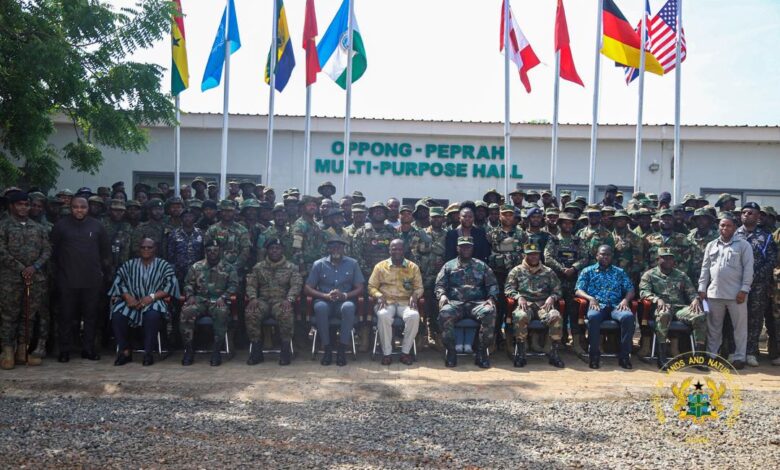
Minister for Lands And Natural Resources Emmanuel Armah Kofi Buah has declared that restoring Ghana’s destroyed forests and water bodies is a duty the country cannot afford to fail, warning that illegal mining has already wiped out 4.4% of forest reserves.
Speaking at the passing-out parade of NAIMOS military personnel at Bundase Military Training Camp on Friday, Buah said government’s strategy blends strict enforcement with new legal pathways for miners willing to operate responsibly.
“The fight against galamsey must be won, and must be won at all costs,” Buah told the troops. “Your assignment is clear. Every forest reserve across this country must turn green again, and we must see water run blue again.”
12,500 Football Fields Of Forest Lost
Buah presented updated figures from the Forestry Commission showing the scale of destruction. As of December 2024, Ghana has lost 8,922 hectares of forest reserve to galamsey. That equals about 12,500 football fields.
The Commission previously estimated 7,000 hectares up to 2021. The new data shows how fast the damage has accelerated.
“When they revised the numbers to the end of 2024, the picture changed completely,” Buah said. “In a short time we have destroyed 12,500 football fields of forest because a few people want quick money and are killing the rest of us in the process.”
He said Ashanti, Western and Western North regions are the worst hit. Some reserves are now “red zones” where forestry officers cannot enter due to heavy arms and the presence of both Ghanaians and foreigners.
Reclaiming the land will cost billions. Buah said replanting and rehabilitation can run into thousands of dollars per acre. For 12,500 hectares, government may need to spend over $10 billion.
Rivers Turning Brown, Water Security At Risk
The minister warned that Ghana’s three main water basins are under serious threat. The Volta, South Western and Coastal basins are all affected, but the South Western basin is the most damaged. Rivers like the Pra, Ankobra and Offin are now brown from chemical pollution.
“Ghanaians look at water that should be blue and see brown instead,” Buah said. “The problem is not just color. It is poison. When the last tree is gone, we are all dead. Eighty percent of our water comes from forests.”
He added that small-scale mining now accounts for 52% of Ghana’s gold output. That makes regulation and legal alternatives urgent, not optional.
Cooperative Mining Offered As Legal Path
To protect livelihoods, government is rolling out a Cooperative Mining Program region by region. Buah said the program is designed to give illegal miners a structured alternative.
“This is to assure you that there is another way,” he said. “If you want to mine, government will identify a site for you, train you, give you proper tools and help you mine responsibly and sustainably.”
He drew a clear line for those who refuse. “For those who choose destruction over alternatives, who want to keep destroying our water and forests, it will be enforcement and forceful action.”
Buah said President John Dramani Mahama has promised full resource support for security forces. He urged NAIMOS personnel to resist corruption and remain disciplined.
“Be careful, be vigilant. People will try to corrupt you. I know you will prove them wrong. Go out and save the soul of our republic,” he said.
He admitted progress has been slow. “Have we removed all the brown water? No. Are we where we want to be? No. Have we made progress in the last year? Yes. Do we still have a lot of work? Absolutely.”
National Security Coordinator Calls Galamsey Existential Threat
National Security Coordinator DCOP Abdul-Osman Razak echoed Buah’s urgency, describing galamsey as a “national emergency bordering on existential.”
“If we do not act now, in a few months or years the Ghana Water Company will not be able to provide safe water to most citizens,” Razak told the graduating troops. “This is about saving the whole of Ghana.”
He said a multi-agency taskforce has been working for nine months on regulation, enforcement, investigation and arrests. He asked personnel to understand the weight of the mission.
“You are here to save the whole of Ghana. It is about real people who do not understand the consequences of their actions,” he said.
Razak laid down strict rules of engagement. National Security operatives will not fight miners directly in the field. Their role is intelligence gathering only. He also warned that National Security has no uniforms and will not issue ID cards. Anyone flashing an ID should be arrested.
He stressed cooperation with the Ghana Police Service and other agencies, and urged discipline on social media. “By the time misconduct hits social media, the damage is done. Be careful how you execute your task.”
Cross-Border Pressure Mounts
Ghana has stepped up the fight against galamsey amid pressure from neighbors over transboundary environmental damage. Pollution of shared rivers and deforestation have become diplomatic concerns.
With forests vanishing, rivers poisoned and reclamation costs soaring, officials say the next phase of the fight will test Ghana’s resolve. For Buah and Razak, the message to NAIMOS troops is the same: this battle is about survival, and it must be won.