Borders as Bridges: West Africa Moves to Redefine Cross-Border Cooperation
Ghana has hosted a high-level sub-regional consultation bringing together National Boundary Commissions from Ghana, Burkina Faso, Côte d’Ivoire, and Mali to strengthen coordinated management of shared international boundaries.
The two-day workshop, supported by Germany’s Federal Foreign Office and the International Organization for Migration [IOM], opened in Accra on Wednesday. Leaders said the meeting marks a decisive step toward ensuring borders serve as bridges for unity, trade, and prosperity, not barriers.
Borders as hubs, not barriers
Speaking at the opening, Minister for Lands and Natural Resources Hon. Emmanuel Armah-Kofi Buah described the gathering as a milestone in advancing peaceful boundary governance and deepening regional integration.
The Minister said the consultation builds on Ghana’s recent national stakeholder workshop convened by the Ghana Boundary Commission. Those outcomes, he noted, reinforced the need for coordinated institutional action, inclusive stakeholder engagement, and data-driven planning to manage increasingly complex border dynamics.
“With borders serving as hubs of trade, cultural exchange, and livelihoods, they are equally vulnerable to threats such as irregular migration, smuggling, transhumance-related conflicts, and environmental degradation,” Hon. Buah said.
Addressing these challenges, he added, requires “collective, forward-looking strategies anchored in trust and cooperation rather than isolated national responses.”
Aligning national and regional priorities
Commissioner-General of the Ghana Boundary Commission, Major General Anthony Ntem, said the consultation is the culmination of extensive national engagements across the four countries. Each state has undertaken internal reviews to align boundary governance priorities, with Ghana’s efforts guided by its 10-year strategic framework.
“These consultations exposed a critical reality: fragmented approaches to border management are no longer viable in the face of evolving regional challenges,” Maj. Gen. Ntem said.
IOM Chief of Mission Mrs. Fatou Diallo Ndiaye said the meeting takes place under the Integrated Border Stability Mechanism for West Africa , a multilateral platform supporting states to address border-related and cross-border challenges in a coordinated, evidence-based manner.
She noted that discussions are grounded in Joint Baseline Assessments conducted across IBSM member states, which highlighted gaps and the need to strengthen governance frameworks and institutional coordination.
Day 1 focuses on frameworks and joint action
Day 1 of the workshop covered project overviews, policy reviews, and assessment of institutional achievements under IBSM.
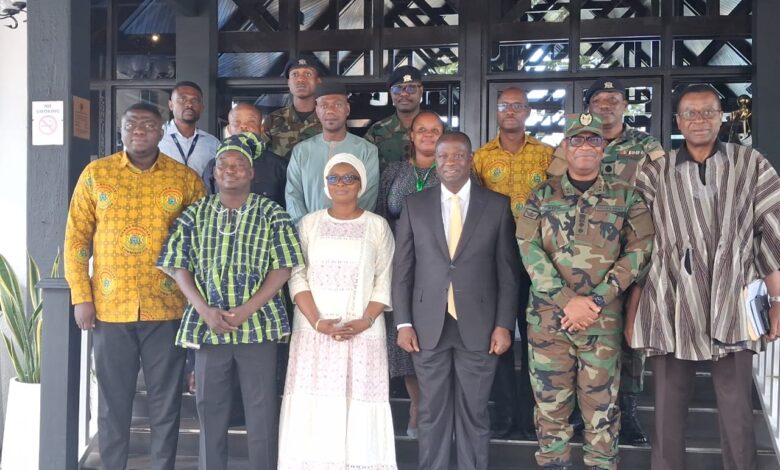
The opening ceremony included remarks from the Ghana Boundary Commission, IOM, and the Minister for Lands and Natural Resources, followed by a group photograph and introductions.
Technical sessions featured presentations on the Integrated Border Stability Mechanism, the Regional Border Stability Project, and IOM’s approach to community engagement. National Boundary Commissions from Burkina Faso, Côte d’Ivoire, Ghana, and Mali also outlined their priorities for international boundary governance.
Facilitators Daniel Tagoe and Hamidou Dipama led discussions on implementing the Framework Agreement on Cross-Border Cooperation. In the afternoon, participants identified and reviewed joint priorities, focusing on community engagement and cross-border cooperation.
Looking ahead
Organizers said the workshop aims to translate agreements into practical actions that enhance border management, conflict prevention, and community resilience across the sub-region.
The Federal Foreign Office, IOM, and UN Migration are backing the process as part of ongoing regional stabilization efforts in West Africa.
Day 2 is expected to focus on next steps and concrete commitments from participating countries.