Embassy Ghana Launches Alumni Speaker Series with Call to Build Systems, Tell Authentic Stories in Creative Industry
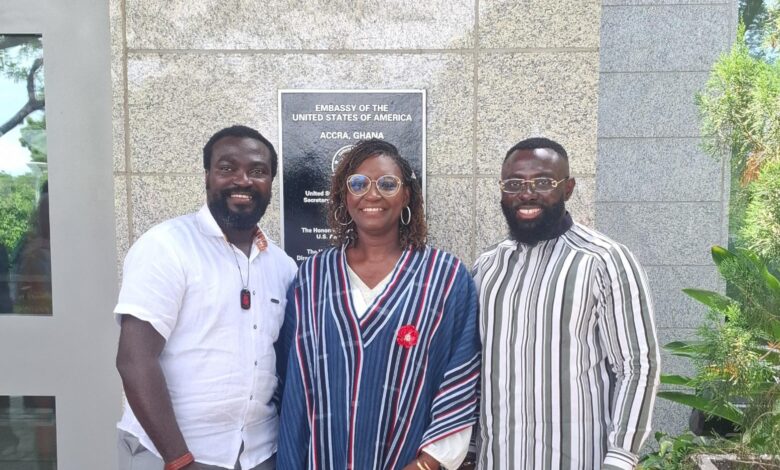
U.S. Embassy Ghana opened its new U.S. Government Exchange Alumni Speaker Series on Tuesday with a candid conversation on what it will take for Ghana’s creative industry to compete globally: stronger systems, authentic storytelling, smarter marketing, and a willingness to reinvent.
Held at the U.S. Embassy in Accra, the event marked the first in a year-long series celebrating 250 years of U.S. independence and the partnership between Ghana and the United States. The session, titled “American Excellence in Film and the Influence of Exchange Alumni on Ghana’s Creative Industry,” brought together two of Ghana’s leading creatives, both U.S. exchange alumni, for a practical masterclass on the business of storytelling.
Setting the stage
Delivering welcome remarks, Donya Eldridge, Cultural Affairs Attaché at the U.S. Embassy Ghana, said the series was designed to spotlight alumni who are “leaders, innovators and change makers who bring American excellence back to their communities and industries.”

Donya Eldridge, Cultural Affairs Attaché at the U.S. Embassy Ghana,
“Alumni programming is something that is very near and dear to my heart,” Eldridge said. “We know that our alumni are amongst the best that Ghana has to offer, and so we love when we have an opportunity to be able to share who they are, what they’ve learned in their experiences.”
She described the initiative as the start of “many conversations” that will showcase alumni impact across the country as the U.S. marks 250 years this July.
Moderating the session was Enock Yeboah Agyepong*, sustainable creator director, cultural curator, and event host, who guided the discussion and opened the floor for audience engagement.
“Marketing is not an afterthought,” says Juliet Asante*
Filmmaker and Black Star International Film Festival founder *Juliet Asante* urged Ghanaian creatives to treat marketing as a core part of production, not an afterthought.
“When you’re doing a production, you should have a marketing budget,” she said. “A lot of films do not have it. It’s like after the film, then it’s like, ‘oh, okay, now what do we do?’”
Asante noted that in mature markets up to 30% of a film’s budget goes to marketing. Without it, even strong films disappear. Using a familiar analogy, she said, “Doing something without marketing is like winking in the dark to a woman. You know what you’re doing, she can’t see what you’re doing.”
She also called for a return to authentic Ghanaian storytelling. Citing the Chinese series Pursuit of Jade_, which has crossed a trillion views despite being in Chinese, she argued that global audiences want cultural specificity.
“They are telling their story in their own language. They are not trying to tell my story,” she said. “The global terrain is open for our stories. They are hungry to know who you are, where you come from, what food you eat, what you wear. Your grandmother, where did she grow up? Those are the stories we need to think about.”
At 52, with 35 years in the industry, Asante said survival has depended on constant reinvention. “You have to touch your darkness. You have to touch your shadow. Don’t run away from who you are. Don’t run away from your story.”
Persistence, she added, matters more than talent. She recalled auditioning for almost a year before landing her first role. “The person who succeeds is not the person who is talented. It’s the person who did it one more time when everybody else stopped.”
Asante closed by announcing a mentorship program launching in June to help young creatives navigate storytelling, production, and career sustainability.
“Ghana needs systems, not just talent,” says Kofi Asamoah*
Filmmaker and KOFAS Media CEO *Kofi Asamoah* shifted the focus to infrastructure, arguing that Ghana’s main gap is not creativity but systems.
“I realized that the biggest strength of the United States is not in their talent, it’s not in their storytelling. It is actually in working systems,” he said.
In the U.S., he said, creativity is treated as an industry with documented intellectual property, residuals, clear distribution pipelines, and investor trust. In Ghana, it remains largely seen as entertainment or a hustle.
“When you go to America, documents are respected, intellectual property ownerships are documented, residual systems exist. Broadcast ethics are fundamental. In the end, great films are made. In the end, monies are made. Industries are built,” he said.
Asamoah pointed to the lack of data on the creative sector’s contribution to Ghana’s GDP as a major barrier to investment. He also noted resistance to transparency, recalling that when he announced production dates and budgets in advance, he was questioned for doing so.
“I was not seeing film as entertainment. I will not shoot until I know where to sell,” he said.
He stressed that Ghana does not lack stories, but the ability to monetize them at scale. “Our problem is monetizing the stories. Otherwise, we will have people tell our stories not as much as we will tell it, but they will sell it to us more than we would have sold to them.”
Asamoah revealed that his company is building a dedicated desk for AI-generated vertical videos and series, saying the earlier Ghana embraces AI, the better positioned it will be. He also encouraged young creatives not to wait for gatekeepers. “You don’t have to wait for Kofi Asamoah to put you on TV to become popular or famous. Create the content yourself.”
Looking ahead
The Exchange Alumni Speaker Series will continue throughout 2026, highlighting alumni contributions across business, governance, education, and innovation as part of the Embassy’s 250th anniversary programming.