Mahama challenges ECOWAS leaders to turn integration promises into action
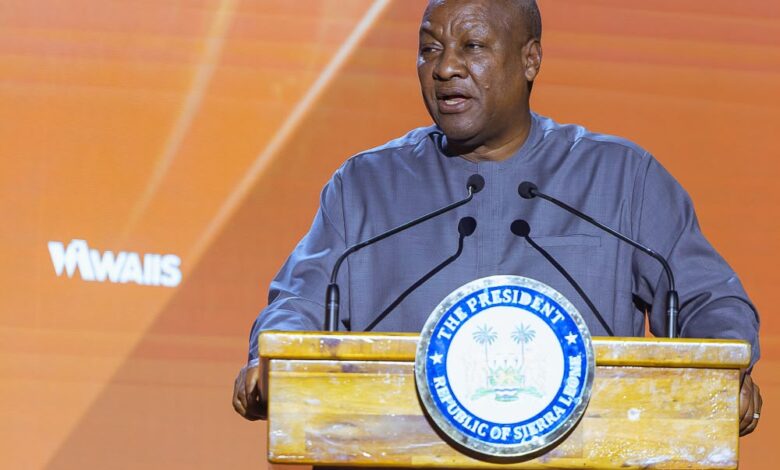
President John Dramani Mahama has challenged leaders of the Economic Community of West African States (ECOWAS) to move beyond rhetoric and take concrete steps to accelerate regional integration, remove trade barriers and unlock the economic potential of the sub-region.
He said despite decades of commitments to regional cooperation, West Africa continued to struggle with obstacles that hinder the free movement of goods, services, capital and people among member states.
Speaking at the West Africa Integration and Investment Summit (WAIIS) in Sierra Leone, President Mahama said the time had come for ECOWAS to translate its longstanding integration agenda into practical results that directly benefit citizens, particularly young people.
“Our community, the Economic Community of West African States, was formed in 1975. If you look at common markets and regional integration, ECOWAS is one of the oldest in the world,” he said.
He, however, questioned why the regional integration project had made limited progress despite its long history.
“And so the question we ask is, where did we go wrong? And how did our integration project become so stalled? And that is what we need to discuss,” he stated.
President Mahama observed that ECOWAS had largely operated as an organisation of heads of state rather than a community owned by its citizens.
“For many years, ECOWAS remained at the level of Heads of States. Anytime we heard about ECOWAS, it is because there was a summit and our leaders were meeting,” he said.
He added that the time had come for ordinary citizens, especially young people, to take ownership of the regional integration agenda.
“So it was an ECOWAS of Heads of States. It was not an ECOWAS of the people, especially the young people. And so the time has come for us to own ECOWAS as our own,” he stressed.
The President identified political will and leadership commitment as critical to dismantling the barriers that continue to undermine regional trade.
“There has been too much lip service paid to integration. But we all know what the obstacles to integration are. It is the political will and the leadership to remove those obstacles that we need now,” he said.
He cited the ECOWAS Trade Liberalisation Scheme (ETLS), adopted in 1990, as an example of an existing regional framework whose benefits had not been fully realised.
The scheme was designed to facilitate the movement of qualifying goods among member states without customs duties and taxes.
However, President Mahama lamented that businesses continued to encounter multiple checkpoints, bureaucratic procedures and additional certification requirements when transporting goods across borders.
“Try to move goods from Freetown to Accra, and you will regret it and never try again. Try to move goods from Accra to Lagos, and you get so frustrated that you will not try again,” he said.
He noted that despite the existence of the ETLS certificate, businesses still faced non-tariff barriers that made cross-border trade difficult.
According to him, trade among West African countries remained between 12 and 15 per cent, a figure that had stagnated for several years.
President Mahama called for deliberate investments in transport infrastructure, logistics and efficient border systems to facilitate trade and strengthen economic cooperation.
He also urged governments to recognise their role as facilitators of private sector growth rather than operators of businesses.
“Government is the enabler. Government cannot be the operator. So we need government, we need the financial institutions, and we need the private sector,” he stated.
He explained that governments must provide macroeconomic stability, strengthen the rule of law, ensure accountability and develop the infrastructure required to attract investment.
The President further called on African financial institutions to provide affordable financing to support strategic infrastructure and private sector projects across the region.
He identified agriculture, mineral resource management, electricity interconnection and regional transport infrastructure as four critical areas requiring urgent attention.
On agriculture, he urged West African countries to reduce dependence on imported food products by investing in local production and processing.
He argued that exporting raw materials while importing finished products deprived African economies of opportunities to create jobs and retain wealth.
“Any time we eat that foreign rice or we eat the foreign chicken, we are exporting value and importing poverty,” he said.
President Mahama also called for greater African ownership and control of mineral resources, insisting that the wealth generated from natural resources must translate into improved living conditions for citizens.
“African minerals must be a source of wealth and prosperity for African people,” he declared.
On regional electricity cooperation, he called for increased investment in interconnected power grids to enable countries with excess electricity to supply those experiencing shortages.
He said electricity traded through the West African Power Pool currently accounted for about seven per cent of regional electricity exchange and expressed confidence that the figure could rise to nearly 30 per cent within five years with the necessary investments.
“You cannot industrialise when you do not have affordable power,” he cautioned.
President Mahama also criticised the slow progress of major regional transport infrastructure projects, particularly the Abidjan-Lagos corridor, which he said had remained on the drawing board for decades.
He called for accelerated implementation of the project, including the establishment of common border posts to eliminate unnecessary security and police barriers.
On monetary integration, he reiterated his support for a gradual introduction of the proposed ECO common currency, suggesting that countries ready to adopt it should be allowed to begin while others join later.
He proposed that the ECO initially operate alongside national currencies and serve as a settlement currency for trade among participating countries, reducing reliance on the United States dollar.
President Mahama congratulated Sierra Leonean President Julius Maada Bio for advancing the West Africa Integration and Investment Summit initiative, describing it as an opportunity to bring governments, financial institutions and private sector players together to accelerate regional development.
He expressed hope that the summit would provide the platform for practical decisions and stronger collaboration among stakeholders.
“I just pray and hope that this very good initiative my brother, Julius, has started, that is the West African Integration and Investment Summit (WAIIS), will be the kind of key that brings ECOWAS leaders, brings the ECOWAS Commission, brings the private sector, brings the financial institutions and everybody together so that finally we can begin to move this integration process forward,” he said.