BoG First Deputy Governor identifies barriers to Asian investment in West Africa
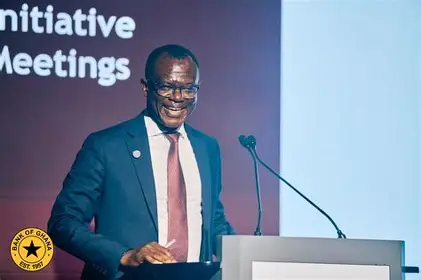
BoG First Deputy Governor Dr Zakari Mumuni has identified investor confidence, policy uncertainty and inadequate financing structures as key barriers limiting the flow of Asian capital into West Africa, calling for stronger partnerships to unlock investment opportunities.
Speaking at the High-Level West Africa–Asia Capital Dialogue on Thursday, October 15, on the sidelines of the IMF–World Bank Annual Meetings, Dr Mumuni said the region’s challenge was not a shortage of capital or investment opportunities, but concerns about risk, confidence and the structures needed to facilitate investment.
He outlined three key observations from Ghana’s perspective, noting that investor confidence, predictable policies and effective investment frameworks were essential to attracting greater capital inflows.
According to him, while macroeconomic stability is necessary, it must be supported by credible institutions, predictable policies and well-prepared projects capable of attracting long-term financing.
He added that practical financing arrangements and strategic partnerships were equally important in turning investment opportunities into viable projects.
Dr Mumuni said Ghana’s recent economic experience demonstrated the importance of sound macroeconomic management in restoring investor confidence.
He noted that high inflation, exchange-rate pressures, debt challenges and limited access to international capital markets had necessitated difficult but necessary policy adjustments and extensive reforms.
However, he said the measures were beginning to yield positive results, including a significant decline in inflation, improved debt sustainability and upgrades to Ghana’s sovereign credit ratings.
“Those efforts are now yielding results. Inflation has eased considerably, debt sustainability has improved, and Ghana’s sovereign credit ratings have been upgraded. Our recent stabilization demonstrates that decisive and credible policy action can restore confidence and reposition an economy for investment,” he said.
Dr Mumuni explained that macroeconomic instability increases investment risks, raises financing costs and discourages long-term commitments. Conversely, price stability, sustainable public finances and credible institutions provide a stronger foundation for private-sector growth.
He said the Bank of Ghana’s responsibility was to maintain monetary and financial stability while strengthening confidence in the economy.
However, he stressed that stability alone could not guarantee sustainable investment, which also depended on a strong pipeline of productive opportunities and competitive businesses.
Dr Mumuni identified several concerns that continue to influence investment decisions, including exchange-rate and financing risks, regulatory and policy uncertainty, contract enforcement challenges, infrastructure constraints, and difficulties associated with project exits and risk management.
He also emphasised the importance of proper project preparation, explaining that development needs did not automatically translate into commercially viable investment opportunities.
“Projects must be commercially viable, properly structured, supported by credible feasibility studies, and accompanied by transparent risk allocation mechanisms,” he said.
He urged West African institutions to improve project preparation, transparency and regulatory predictability, while encouraging investors to assess opportunities on their individual merits rather than relying on broad perceptions of the region.
According to him, investment conditions differ considerably across West African countries and should be evaluated accordingly.
Dr Mumuni identified agro-processing, manufacturing, energy, transport and logistics, digital services, and financial technology as sectors offering significant investment opportunities in Ghana.
He said investment in these areas could accelerate economic transformation and create employment.
Beyond Ghana, he pointed to the African Continental Free Trade Area (AfCFTA) as an opportunity for investors to access a wider regional market.
However, he said unlocking the potential of the continental market would require improvements in trade facilitation, logistics, payment systems and dispute resolution mechanisms.
He stressed that the opportunity extended beyond financing individual projects to building productive capacity, developing regional value chains and establishing sustainable commercial partnerships.
To improve the flow of Asian capital into West Africa, Dr Mumuni outlined four priorities for policymakers, development finance institutions and investors.
First, he called for stronger risk-sharing arrangements involving development finance institutions, export credit agencies, governments and private investors, with risks allocated to parties best equipped to manage them.
Second, he advocated improved project preparation to develop a strong pipeline of investment-ready opportunities capable of attracting long-term capital.
Third, he urged stakeholders to adopt appropriate financing structures, noting that long-term investments required long-term financing. He added that greater use of local-currency financing, where feasible, could reduce currency mismatches and improve project viability.
Fourth, he called for stronger institutional partnerships that combine Asian capital and expertise with African market knowledge and investment opportunities.
“We need enduring partnerships that combine Asian capital and expertise with African market knowledge and opportunities,” he said.
Dr Mumuni noted that central banks could not guarantee the commercial success of individual investment projects but had a responsibility to create a stable and credible monetary and financial environment.
He said this involved maintaining price stability, safeguarding financial stability, supporting efficient payment systems and ensuring transparent foreign exchange arrangements.
He added that the Bank of Ghana was interested in innovations that improve cross-border payments and facilitate trade and investment, provided they were supported by appropriate safeguards for resilience, integrity and regulatory compliance.
As part of the way forward, Dr Mumuni proposed four practical measures: identifying priority sectors and projects with genuine commercial appeal to Asian investors; establishing structured engagement channels between African project sponsors and Asian investors; expanding cooperation in trade finance, payment connectivity and local-currency financing; and creating a mechanism to track progress against clear targets and timelines.
He said the ECOWAS Bank for Investment and Development (EBID), alongside other regional development finance institutions, could play an important coordinating role in advancing the agenda.
Dr Mumuni maintained that West Africa had significant investment opportunities, but unlocking them would require credible policies, strong institutions, well-prepared projects, effective risk-management frameworks and robust partnerships.
He urged African countries to make their opportunities more attractive to investors while encouraging international partners to evaluate those opportunities objectively and work with local stakeholders to develop commercially viable solutions.
He concluded that the success of the dialogue should be measured not by the number of meetings held, but by the investments secured, businesses expanded and partnerships sustained.
By Esther Padmore Amonoo