Mahama calls for stakeholders’ forum on regulation of TikTok, new media
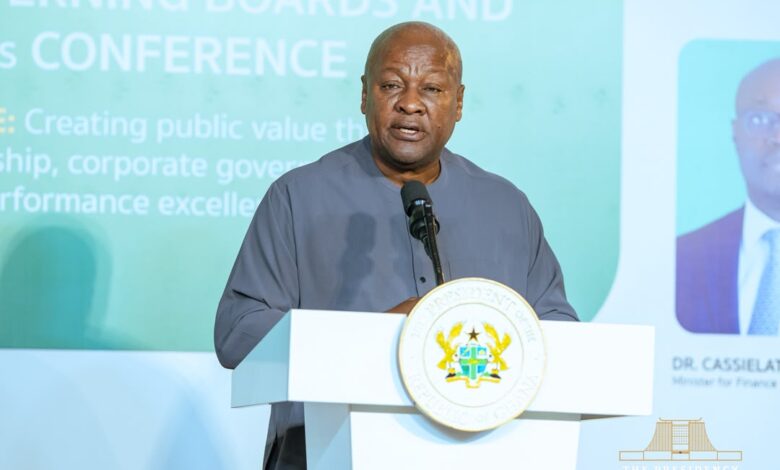
President John Dramani Mahama has called for a stakeholders’ forum to determine how Ghana should regulate TikTok and other new-media platforms, which have increasingly become channels for misinformation, disinformation and abusive content.
He said the growing influence of TikTok had become a global concern because of its implications for information integrity.
“There is a new term that I call information integrity.
The media has become democratised.
Anybody with a mobile phone can disseminate information.
There is a new media called TikTok.
And it’s not only Ghana where people are wondering what to do to regulate TikTok.
Because in all countries all over the world, we are wondering what to do to make sure that we have information integrity even with TikTok,” the President said.
President Mahama was responding to a question about the arrest of individuals in connection with misinformation and disinformation during a town hall meeting with the Ghanaian community in New York last Friday.
He proposed that the Ghana Journalists Association (GJA) and the Media Foundation for West Africa (MFWA) bring together relevant stakeholders to deliberate on the issue and make recommendations on how new media should be regulated.
“What we should do is for the Ghana Journalists Association (GJA) and Media Foundation for West Africa (MFWA) to bring all the stakeholders together and hold a workshop or a forum.
“Let’s all collectively take a decision on what we want to do with the new media.
Should the police get involved or shouldn’t they get involved?
How do we regulate it? You come out and tell us,” he said.
President Mahama said the government had tasked the GJA and MFWA with organising the forum, adding that its recommendations would be submitted to the government to help develop guidelines on how such cases should be handled.
Arrests over misinformation and insults
The President said several arrests relating to misinformation and insults had come to his attention through media reports, adding that he was sometimes concerned when individuals were allegedly arrested for insulting him.
“Definitely, a lot of these arrests, I don’t even know about them. I also hear them from the media.
Some of them have been tracked and arrested and all that.
And sometimes, it worries me, because sometimes the reason for which the person has been arrested, really, they say, is because he insulted me,” he said.
TikTok versus traditional media
President Mahama also drew a distinction between TikTok and traditional media outlets such as the Daily Graphic and Channel One, where journalists put their professional reputation behind the stories they publish.
He said social media platforms had made it possible for virtually anyone with a mobile phone to publish information, with algorithms then helping to distribute similar content to users.
“Anybody who has a phone just puts it in front of him and just says whatever he likes. Once they put it out, it has an algorithm that shares it,” he said.
According to the President, the use of TikTok and other platforms in Ghana has also been accompanied by increased insults and abusive content, with some individuals using anonymous accounts to publish what he described as vile material.
“As a leader, I don’t mind being insulted. I’ve been insulted.
I was vilified. I was voted out of office. I have a tough skin; so if you insult me, I don’t mind,” he said.
Free expression and police intervention
However, President Mahama said the government could choose to allow unrestricted freedom of expression and refrain from police intervention, but questioned whether that was the approach Ghanaians wanted.
“I can tell the IGP, we can go to Cabinet and say, let anybody insult anybody. Let’s leave it free for all.
Don’t arrest anybody for anything they say. We can do that. But is that what we want?” the President asked.
He said the government would rely on the collective views of stakeholders in determining whether, and to what extent, the police should be involved in regulating new media.
President Mahama cautioned that police intervention could sometimes go too far, noting that once arrests begin, it could become difficult to determine where to draw the line.
“So, let’s all decide what we want to do.
So that we either find a way of regulating it or we say, when it comes to free expression, anybody can say whatever he wants,” he said.
He stressed that while Ghanaians value freedom of expression, that freedom should not be interpreted as an absolute licence to say anything without consequences. He cited the example of threatening the President of the United States, saying such conduct would attract swift action.