President Mahama calls for stronger, long-term partnerships with global philanthropies
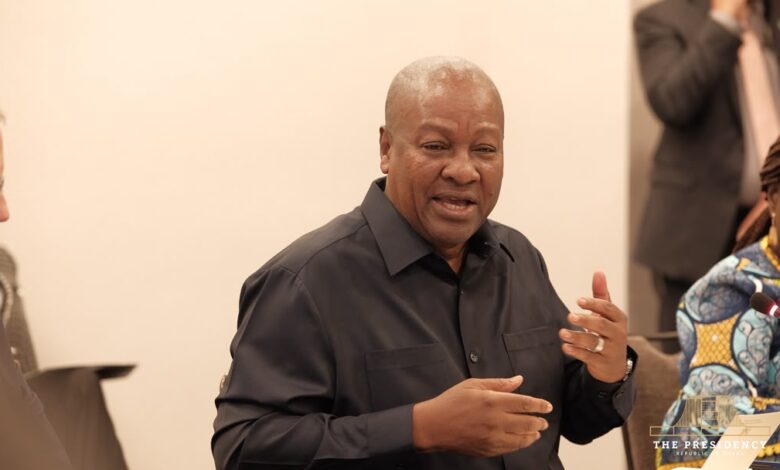
President John Dramani Mahama has called for a new approach to Ghana’s engagement with global philanthropic organisations, urging a shift from fragmented, short-term interventions to partnerships focused on strengthening institutions, building local capacity and achieving development goals aligned with Ghana’s priorities.
President Mahama made the call at a high-level presidential funders’ roundtable in New York, attended by about 20 major US-based philanthropic organisations and foundations, including the Gates Foundation, Open Society Foundations, Rockefeller Foundation, Hilton Foundation and Ford Foundation.
The engagement, organised by the Open Society Foundations on the sidelines of the 81st United Nations General Assembly, brought together senior representatives of leading global foundations to discuss a new model for international development cooperation.
The President said the changing global development environment offered Ghana and other countries in the Global South an opportunity to reconsider how they engage international development partners.
According to him, the focus should not only be on finding alternative sources of funding when traditional development finance changes, but also on strengthening institutions so countries can take greater ownership of their development.
“Development finance can change quickly. Funding priorities shift, and political decisions taken thousands of miles away can have immediate consequences for programmes, institutions and communities in our countries,” he said.
President Mahama noted that Africa already has a clear development framework under Agenda 2063, but stressed that the major challenge remains translating those ambitions into tangible results.
He said this would require institutions capable of delivering, stronger resource mobilisation and management systems, improved negotiating capacity, programmes that can attract appropriate financing and systems that ensure accountability and learning.
President Mahama said Ghana’s Accra Reset initiative is based on the principle that national sovereignty must be supported by the capacity to exercise it effectively.
He said greater country ownership would require governments to establish clear priorities, improve coordination and financial management, and strengthen institutions capable of delivering measurable outcomes.
“We cannot ask our partners to give us greater room to lead while avoiding the difficult work that leadership requires,” the President said.
He also urged international development partners to assess whether their own approaches adequately support national institutions and provide governments with sufficient space to lead.
According to him, philanthropic organisations have a unique role because they can support areas that may not easily attract conventional development financing or commercial investment.
He identified institutional capacity building, early-stage programme development, public goods, social priorities and evidence generation as areas where philanthropic support could have a significant impact.
“The value of an intervention may lie in the institution that becomes stronger, the evidence that leads to a better public decision, the programme that becomes ready for larger-scale financing, or an approach that proves itself and can then be taken further,” he said.
The President further called for greater coordination among philanthropic organisations, warning that fragmented funding arrangements could place additional pressure on national institutions through multiple funding cycles, reporting requirements and due-diligence processes.
A key part of the President’s proposed approach is the role of the Millennium Development Authority (MiDA) as Ghana’s institutional gateway for global philanthropic partnerships.
President Mahama said his decision to designate MiDA as the government’s focal institution for international philanthropic partnerships and grant coordination was intended to create a clear and credible channel for foundations seeking to work with Ghana.
“MiDA gives us an institution with experience of working to demanding international standards of procurement, financial management, delivery and accountability,” he said.
He explained that MiDA would connect philanthropic partners with relevant government institutions while ensuring that ministries, the Accra Reset team, civil society organisations and other delivery partners remained involved.
The President stressed that greater country ownership should not come at the expense of high standards.
“Our responsibility is to build institutions capable of meeting those standards and to give partners confidence that resources can be traced, results can be demonstrated and lessons from implementation can inform what happens next,” he said.
President Mahama invited the foundations represented at the roundtable to move beyond traditional funding arrangements and explore partnerships in which their expertise, networks, research and institutional capabilities could complement Ghana’s development priorities.
He said the form of support required would depend on the specific development challenge, noting that some areas may require grants, while others could benefit from technical expertise, research, institutional support or philanthropic capital capable of attracting additional development financing and private investment.
“Ghana, for its part, must be prepared to lead, coordinate and account for what follows,” he said.
He added that MiDA would serve as a channel for philanthropic organisations interested in working with Ghana to continue discussions and connect with the appropriate government institutions.
President Mahama expressed the hope that Ghana could demonstrate that stronger national leadership can go hand in hand with accountability, while ensuring that philanthropic partnerships build institutions and capabilities that remain effective beyond individual grants.
The roundtable formed part of President Mahama’s wider engagements during the 81st United Nations General Assembly and reflects his broader call for international partners to move away from short-term interventions towards long-term institutional and capacity building.
By Esther Padmore Amonoo