We cannot fix a decade of network neglect in one year-Sam George
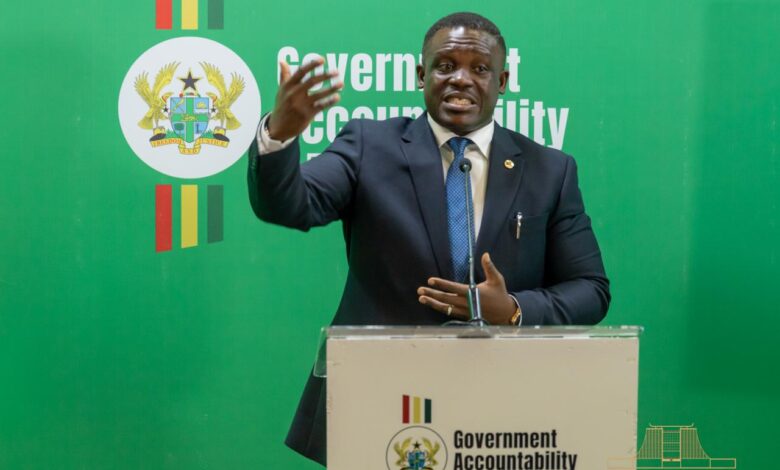
Minister for Communication, Digital Technology and Innovations, Samuel Nartey George, has acknowledged persistent challenges with Ghana’s telecommunications network, saying the government cannot reverse nearly a decade of inadequate investment and regulatory shortcomings within a single year.
Speaking at the Government Accountability Series, Mr George said the country’s shift from a voice-driven telecommunications market to a data-driven economy had not been matched with the necessary investment in network infrastructure.
He said the situation had resulted in network congestion and coverage gaps in several parts of the country, particularly rural and peri-urban communities.
“We cannot fix a decade of neglect in one year, but considerable steps have been made through the regulator. We are correcting that anomaly,” he said.
According to the Minister, for almost 10 years, insufficient policy and regulatory action had been taken to compel operators to make investments that reflected the rapidly changing demands of Ghana’s digital economy.
He said the government was therefore pursuing measures to expand connectivity, improve network capacity and modernise the technology supporting telecommunications services.
Mr George disclosed that the National Communications Authority (NCA) had undertaken significant reforms to Ghana’s 5G policy, following regulatory, economic and legal assessments.
He said the NCA Board approved on July 15, 2026, the removal of the wholesale 5G exclusivity framework, which had limited competition in high-speed mobile broadband.
Requests for applications for spectrum in the 700MHz, 2.3GHz and 3GHz bands have subsequently been issued, opening the sector to additional investment, he said.
The Minister also highlighted increased investment by telecommunications companies as part of efforts to address network challenges.
He said MTN Ghana had committed more than US$1.1 billion over the next three years, including approximately US$380 million in 2026, to expand network coverage, deploy new sites and support its 5G rollout.
He said the company had planned to build 800 new cell sites in 2026, describing it as the highest annual site construction programme undertaken by the company in a decade.
According to Mr George, the new sites are being targeted particularly at rural and peri-urban communities where network challenges have been more pronounced.
He said 180 of the 800 sites had already become operational and were carrying traffic.
The Minister also said Telecel Ghana had increased its capital investment by about 60 percent over the 2023–2026 period compared with the preceding four years.
He disclosed that Telecel had a 2026 plan targeting 2,698 sites, of which 1,890 had already been upgraded and made 4G-compliant.
Mr George said the government was also paying particular attention to the quality of infrastructure in rural communities, where many cell sites still operate on legacy 2G and 3G technologies.
He explained that while such networks may adequately support voice calls and text messages, they are increasingly inadequate for services such as mobile money, digital agriculture, e-learning, telemedicine and other digital services.