Punish Those Who Destroyed Ghana’s Only Grains and Legumes Facility in Ashanti Region

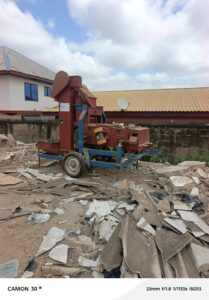
The President of United States Africa Command-Ghana (AFRICOM-GHANA), Mr Abednego Orstin Rawlings, has called on the President of the Republic of Ghana, His Excellency John Dramani Mahama, and the Asantehene, Otumfuo Osei Tutu II, to take action against Nana Adjei of the Atwima Stool for the alleged demolition of facilities belonging to the Grains and Legumes Development Board under the Ministry of Food and Agriculture in the Ashanti Region.

According to him, the land was acquired by the Republic of Ghana in the 1970s for the establishment of the facility to serve farmers across the country.
He said the then traditional authority voluntarily released the land to the state for the implementation of the project, which was intended to serve a national purpose.
Mr Rawlings said successive sub-chiefs had occupied the stool without destroying state properties located on the land, noting that the facility remained operational until the recent demolition.
He alleged that in 2018, Nana Adjei and some associates went to court to reclaim the land, arguing that it belonged to the stool and should no longer be used for a national purpose.
He questioned why Nana Adjei and his team allegedly pursued the case against staff of the Ministry of Food and Agriculture rather than the Ministry itself.
“Did the Atwima Stool act on its own or under the authority of the Asantehene?” he questioned.
Mr Rawlings further asked why, if the Atwima Stool falls under the authority of the Ashanti Regional House of Chiefs, the relevant traditional authorities were not consulted before the demolition of the state institution on August 5, 2026.
He warned that the development could set a dangerous precedent if other traditional authorities begin seeking to reclaim lands on which the state has established facilities serving the public interest.
“Does it mean that other regional houses of chiefs can also demand the return of parcels of land on which the state has established facilities that benefit Ghanaians?” he asked.
Strategic national asset
Mr Rawlings described the Asuoyeboah Centre, which he alleged was demolished by the Atwima Stool, as a strategic national asset rather than an ordinary property of the Board.
He said the facility was one of the largest seed-processing and storage installations under the Ministry of Food and Agriculture and served as a major facility for the middle belt of the country.
According to him, the centre performed three critical functions of national importance.
Cold storage for the national seed reserve
He said the facility housed the Board’s foundation seed stocks—the class of seed from which certified seed is multiplied—as well as certified seed belonging to private seed producers.
Under Ghana’s humid tropical conditions, he explained, the foundation seed of maize, soybean, cowpea and groundnut can lose germination viability within a few months if it is kept outside temperature- and humidity-controlled storage.
“The cold room was, in practice, the physical guarantee of the viability of the nation’s seed reserve,” he stated.
Central processing hub
Mr Rawlings said the centre also provided cleaning, grading, drying, treatment and bagging services to the Board and, on a cost-recovery basis, to private seed growers.
He said these services generated internally generated funds (IGF) for the Board and non-tax revenue for the Government of Ghana.
Employment centre for women and youth
He further stated that the processing operations provided direct seasonal and casual employment for a significant number of women and young people from surrounding communities.
According to him, the employment opportunities were consistent with the government’s job-creation priorities.
He argued that the demolition had therefore not merely inconvenienced the Board but had removed a functioning link in the national seed value chain, with potential consequences for private-sector operators, seed growers and, ultimately, farmers who depend on certified seed each season.
Mr Rawlings said women and young people employed in sorting, cleaning, grading and bagging at the centre had lost their source of seasonal income without notice or alternative arrangements.
“These are precisely the beneficiaries targeted by government’s job-creation policies, and the loss is concentrated in one community,” he stated.
Revenue loss and seed production concerns on revenue, Mr Rawlings said the Board had lost processing and storage service fees paid by private seed growers, describing the fees as an established IGF stream that reduced the Board’s reliance on the Consolidated Fund.
He added that the Board would now have to incur unbudgeted costs for alternative processing and storage facilities, longer-distance transportation and other logistics.
He said the Board was currently preparing to harvest 50 acres of seed farm at Ejura, 10 acres at Duayaw Nkwanta and another 10 acres at Kwamoso—70 acres in all.
According to him, the seed production programme had been planned and budgeted on the assumption that the harvested seed would be processed and cold-stored at the Asuoyeboah facility.
“The Head Office, which is the only fallback available to us, has neither the processing throughput nor the cold-storage volume to receive it,” he stated.
He warned that unless emergency capacity was secured in the coming weeks, the Board could face the prospect of harvesting 70 acres of foundation seed that could not be properly dried, cleaned, treated or stored.
He said such seed could subsequently be degraded to grain, sold at a fraction of its value or lost entirely.
“That is a direct loss of public investment already committed to land preparation, inputs, labour, field inspection and certification for the current season,” he stressed.
Call for action
Mr Rawlings maintained that state assets established for the benefit of the Republic of Ghana should remain protected and should not be reclaimed through force or unilateral action.
“Ghana first, not the Atwima Stool,” he stated.
He further warned that the actions allegedly taken by Nana Adjei and his team could encourage other traditional authorities to pursue similar actions, which he said could undermine national development.
Describing the development as a negative precedent, he questioned whether traditional authorities such as the Ga Traditional Council and the Ga Regional House of Chiefs should also seek to reclaim lands that had been made available to the Republic for public projects.
“If it is true that Nana Adjei took staff of the Ministry to court rather than the Ministry of Food and Agriculture, and that the court subsequently gave him the authority to demolish the state property, then the laws of the Republic of Ghana must be allowed to take their course,” he said.
Mr Rawlings also alleged that the demolition was carried out without notification to the Ghana Police Service, which he said would raise questions about compliance with the laws of Ghana.
He further alleged that, based on information gathered, Nana Adjei used land guards in carrying out the demolition.
He therefore called on the Ashanti Regional House of Chiefs, criminal Investigation Department(CID),
Bureau of National Intelligence (BNI), National Security Secretariat(NSS), and Ghana Police Service
to investigate the matter and take appropriate action against Nana Adjei and all persons found responsible for the alleged destruction of state property.
He said such action would serve as a deterrent to other traditional authorities and help protect public assets established for the benefit of the people of Ghana.