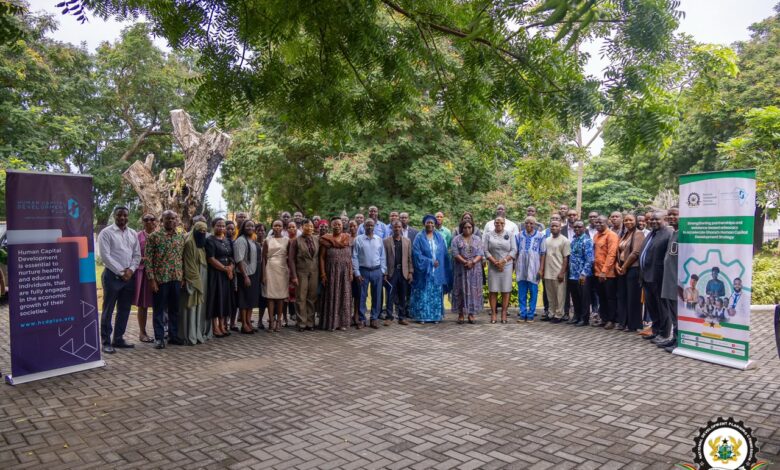
The National Development Planning Commission (NDPC), in partnership with Africa Human Capital Development Plus (Africa HCD+), has opened a three day advocacy workshop to build stakeholder support and strengthen coordination for Ghana’s forthcoming National Human Capital Development Strategy.
The three day workshop, which began on Monday, 27 July 2026 will bring together representatives from ministries, departments and agencies (MDAs), metropolitan, municipal and district assemblies (MMDAs), civil society organisations, development partners, academia and other key stakeholders. The workshop aims to strengthen advocacy, promote collaboration and build broad based ownership to support the development and effective implementation of Ghana’s National Human Capital Development Strategy.
Delivering the opening remarks, the Director General of NDPC, Dr Audrey Smock Amoah, said the workshop forms part of a broader effort to build political, institutional and public support for Ghana’s human capital agenda. She noted that although Ghana has made significant progress in expanding access to education, health and social protection, key human capital indicators continue to present challenges that require urgent and coordinated action.
Dr Amoah stated that junior high school and senior high school enrolment had declined to 58.8 percent and 34.5 percent, respectively, while unemployment stood at about 13 percent in the third quarter of 2025. She further noted that child stunting remained at 17.4 percent, with anaemia affecting nearly half of children under five.
She stressed that Ghana’s human capital policy must bridge education, skills development and employment to drive sustainable national development saying, “ Human capital policy must therefore connect what happens in the classroom and training centres with what happens in the labour market and the wider economy,”
Dr Amoah emphasised that advocacy should not be viewed as an activity undertaken after the strategy has been developed, but rather as an integral part of its implementation. She called on stakeholders to champion the strategy within their respective institutions and communities to ensure sustained commitment and collective ownership.
Delivering a solidarity message, the Chief Executive Officer of Africa HCD+, Madam Finda Koroma, described the workshop as the organisation’s first advocacy engagement in Ghana. She said the initiative builds on previous collaboration with the Ghana Statistical Service on human capital indicators and the organisation’s ongoing partnership with NDPC in developing the National Human Capital Development Strategy.
Madam Koroma observed that Ghana’s World Bank Human Capital Index score stands at 0.45, while the country’s Human Development Index ranks 143rd out of 193 countries. She added that the inequality adjusted Human Development Index declines to 0.399, highlighting the significant impact of inequality on human development outcomes and the need for sustained investment in people.
She stressed that a technically sound strategy alone would not guarantee success . “A technically strong strategy is therefore necessary, but it is not sufficient. It must be understood,communicated, financed, owned and defended,” she said.
Madam Koroma further noted that although countries such as Nigeria and Sierra Leone have developed human capital strategies, Ghana’s strategy would be uniquely designed to reflect the country’s national priorities, institutional arrangements and development aspirations.
Also addressing participants, Mr Louis Quarcoo, of the Office of the President’s 24 Hour Economy Secretariat said the proposed National Human Capital Development Strategy aligns closely with the Secretariat’s Aspire24 Skills Programme, which seeks to equip young people with skills that respond to labour market demands.
He observed that more than 70 percent of Ghanaian firms struggle to recruit skilled workers, while fewer than 20 percent of young people possess digital proficiency. He said these figures underscore the urgent need to invest in skills development, workforce readiness and lifelong learning to enhance productivity and economic transformation.
The workshop is expected to deepen stakeholders’ understanding of Ghana’s human capital priorities, strengthen partnerships across sectors and build a strong coalition of advocates to support the successful implementation of the National Human Capital Development Strategy. It also forms part of ongoing efforts by NDPC and its partners to place people at the centre of Ghana’s long term national development agenda.