Mahama targets 500,000 industrial jobs under 24-hour economy policy
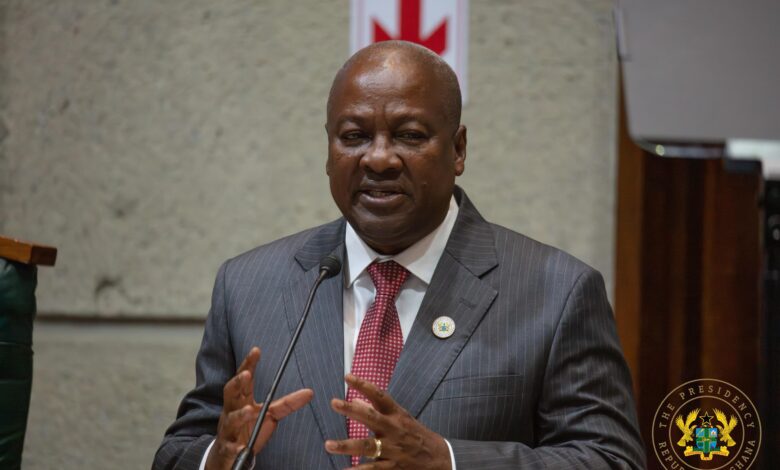
President John Dramani Mahama has announced an ambitious plan to create 500,000 quality industrial jobs by 2030, anchored on the full implementation of his government’s 24-Hour Economy Policy.
Speaking at the inaugural Presidential Dialogue with the Private Sector, President Mahama described the policy as a central pillar of Ghana’s industrial transformation agenda, aimed at increasing manufacturing’s contribution to Gross Domestic Product (GDP) and positioning the country as West Africa’s production hub.
“We need to change our trajectory,” the President declared. “Manufacturing must contribute at least 15 per cent of GDP by the year 2030, supported by 500,000 new quality industrial jobs. This will require structural reform and not incremental adjustments.”
He explained that the 24-Hour Economy Policy, which has now been enacted into law for manufacturers, is designed to maximise productivity by encouraging industries to operate multiple shifts.
“Factories operating one shift produce one shift output; factories operating three shifts maximise capital, infrastructure and labour productivity,” Mr Mahama stated. “This is not mere reform. It is a productivity revolution.”
According to the President, the newly established 24-Hour Economy Authority will coordinate nationwide implementation of the policy, working closely with ministries, regulators and private sector stakeholders.
The policy includes a range of incentives aimed at reducing operational constraints and encouraging expansion. These include shift-based tax incentives, differentiated off-peak electricity tariffs, enhanced nighttime security, structured labour dialogue mechanisms, and tax exemptions on equipment for factory expansion.
President Mahama stressed that energy reform remains central to the success of the initiative.
“No industrial nation thrives under structurally high cost of power,” he said. “Energy reform is not optional. It is foundational to Ghana’s industrial takeoff.”
He indicated that the government would accelerate energy sector debt restructuring, expand renewable energy generation, improve transmission efficiency and promote embedded power generation within industrial enclaves to ensure reliable and competitive electricity supply.
Beyond energy, the President acknowledged that access to affordable financing remains a critical barrier to industrial growth.
“Industrialisation cannot take off when interest rates remain around 18 to 20 per cent and lending tenors are short term,” he noted. “Access to affordable patient capital will be treated as a structural reform priority by this government.”
To address this, he announced plans for dedicated financing windows for manufacturing, expanded credit guarantee schemes, and partnerships with the Bank of Ghana and development finance institutions to provide long-term capital.
President Mahama further emphasised that macroeconomic stability and regulatory clarity would be essential to sustaining investor confidence under the 24-Hour Economy framework.
“Government must commit to maintain stable macroeconomic policy. The turbulence in macroeconomic policy affects your businesses,” he said. “Regulations must be clear and simple and not intended to obstruct private business.”
Calling for renewed collaboration, the President proposed what he described as a “covenant” between government and the private sector.
“The Ghana we all seek will not be built by speeches,” he stated. “It will be built by factories operating at scale… by industrial parks that are producing for Ghana and exporting to Africa and beyond.”
He urged businesses to reinvest profits, expand domestic production, prioritise local content and invest in skills development to ensure that the projected 500,000 jobs translate into sustainable and high-quality employment opportunities for Ghanaians.