Ghana positions itself as West Africa’s steel hub-President Mahama
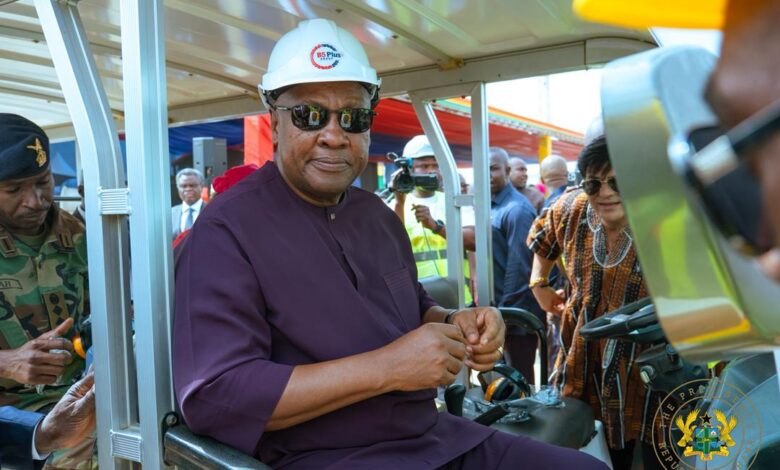
President John Dramani Mahama has declared that Ghana is strategically positioning itself to become West Africa’s steel manufacturing hub, as government intensifies efforts to deepen industrialization and regional trade under the African Continental Free Trade Area (AfCFTA).
Speaking at the commissioning of the Phase Two expansion of the B5 Plus steel manufacturing facility today, President Mahama said the development represents a major step in Ghana’s transition from raw material exports to value-added production.
“Today marks more than the expansion of a factory. It marks the expansion of Ghana’s industrial ambition,” he stated.
Reducing Imports, Building Capacity
Ghana’s annual steel demand is estimated at over 1.2 million metric tonnes, driven largely by construction, energy infrastructure, mining and manufacturing. For years, a significant share of that demand has been met through imports.
“The expansion of this facility strengthens domestic capacity to substitute imports, save foreign exchange, improve our trade balance and stabilize supply chains,” President Mahama said.
He noted that reducing steel imports by even 20 to 30 percent annually could save the country hundreds of millions of dollars.
“This is what industrial sovereignty is about,” he emphasized.
Strategic Advantage Under AfCFTA
President Mahama highlighted Ghana’s political stability, deep-water ports in Tema and Takoradi, expanding energy infrastructure and its role as host of the AfCFTA Secretariat as key advantages.
“Ghana is uniquely positioned in West Africa,” he said. “With a market of 1.4 billion people and a combined GDP exceeding $3 trillion gradually opening up for intra-African trade, steel products manufactured here can serve ECOWAS construction markets, Sahelian infrastructure projects and mining operations across the sub-region.”
He added, “Instead of importing steel from Asia or Europe, West Africa can source competitively from Ghana’s manufacturers. This is regional value chain integration in real practice.”
Linking Infrastructure to Industry
The President tied the steel expansion to government’s “Big Push” infrastructure programme, which includes investments in roads and highways, railway modernization, bridges and interchanges, energy transmission lines, affordable housing and industrial parks.
“All these require iron and steel,” he said. “If Ghana develops a strong steel base, we will not only build our own roads and bridges — we will supply steel to the whole sub-region. This is how infrastructure becomes industrial strategy.”
Africa is projected to require more than $100 billion annually in infrastructure development, with West Africa facing significant deficits.
Scrap Export Ban to Secure Raw Materials
President Mahama reiterated government’s decision to restrict non-ferrous scrap exports to guarantee raw material security for local processors.
“Industrial capacity requires raw material security. For too long, a significant portion of our scrap metal has been exported in its raw form,” he said.
The policy, he added, is expected to boost processed metal exports by between $250 million and $300 million annually while creating between 5,000 and 10,000 jobs.
24-Hour Economy to Support Manufacturing
The President also announced that he had signed the 24-Hour Economy Authority Bill into law, describing it as particularly relevant for energy-intensive industries such as steel manufacturing.
“Steel production benefits from continuous operation to reduce energy wastage, improve furnace efficiency, lower unit production cost and maximize asset utilization,” he explained.
The 2026 Budget has allocated GH¢110 million to operationalize the 24-hour economy programme.
“When factories run three shifts instead of one, employment rises, productivity increases and exports expand,” he said.
President Mahama concluded that Ghana’s industrial transformation will require sustained policy support, infrastructure investment, macroeconomic stability and private sector confidence.
“As host of the AfCFTA Secretariat, Ghana has a responsibility to demonstrate that continental integration can deliver tangible results,” he said. “Regional trade must move beyond speeches and communiqués. It must translate into factories exporting to neighbouring countries.”