From raw scrap to finished steel: Mahama charts industrial shift
President John Dramani Mahama has outlined what he describes as a decisive structural shift in Ghana’s economy — moving from the export of raw scrap metal to the production and export of finished and semi-finished steel products.
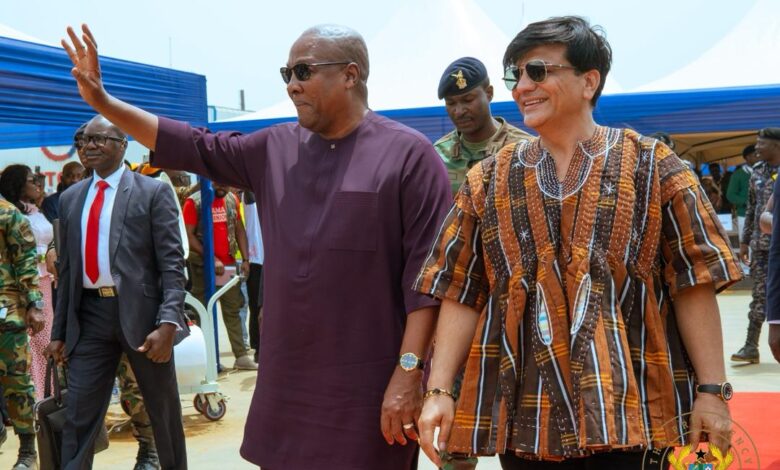
Speaking at the commissioning of the Phase Two expansion of the B5 Plus steel manufacturing facility today, President Mahama said the development represents more than the growth of a single factory.
“Today marks more than the expansion of a factory. It marks the expansion of Ghana’s industrial ambition,” he declared.
According to President Mahama, the expansion forms part of a broader transformation agenda aimed at reducing Ghana’s dependence on raw material exports and strengthening domestic manufacturing capacity.
“We are moving up the value chain. We are exporting finished and semi-finished products, not raw scrap,” he stated.
Reducing Imports, Saving Foreign Exchange
Ghana’s annual steel demand is estimated at more than 1.2 million metric tonnes, driven by construction, mining, energy infrastructure and manufacturing. Historically, a significant portion of this demand has been met through imports, placing pressure on the country’s foreign exchange reserves.
“The expansion of this facility strengthens domestic capacity to substitute imports, save foreign exchange, improve our trade balance and stabilize supply chains,” the President said.
He added that reducing steel imports by 20 to 30 percent annually could save the country hundreds of millions of dollars.
“This is what industrial sovereignty is about,” he emphasized.
Scrap Export Ban to Secure Raw Materials
President Mahama reiterated government’s decision to restrict non-ferrous scrap exports, explaining that industrial growth depends on reliable access to raw materials.
“Industrial capacity requires raw material security. For too long, a significant portion of our scrap metal has been exported in its raw form,” he said.
By prioritizing local processors, he noted, Ghana can increase value addition, boost processed metal exports and generate substantial economic returns.
Regional Market Opportunity
The President said Ghana is uniquely positioned to serve as a steel manufacturing hub in West Africa, citing political stability, deep-water ports in Tema and Takoradi, expanding energy infrastructure and the country’s role as host of the African Continental Free Trade Area (AfCFTA) Secretariat.
“With a market of 1.4 billion people and a combined GDP exceeding $3 trillion gradually opening up, steel products manufactured here can serve construction markets across ECOWAS and the wider sub-region,” he said.
“Instead of importing steel from Asia or Europe, West Africa can source competitively from Ghana’s manufacturers. This is regional value chain integration in real practice.”
Linking Infrastructure to Industry
President Mahama also tied the industrial shift to government’s “Big Push” infrastructure programme, which includes investments in roads, highways, railways, bridges, energy transmission lines, affordable housing and industrial parks.
“All these require iron and steel. If Ghana develops a strong steel base, we will not only build our own roads and bridges — we will supply steel to the whole sub-region,” he stated. “This is how infrastructure becomes industrial strategy.”
He further noted that Ghana’s mining sector — including gold, bauxite, manganese and lithium — requires significant steel inputs, making domestic production strategically important.
24-Hour Economy and Fiscal Support
The President revealed that he had signed the 24-Hour Economy Authority Bill into law, with B5 Plus expected to be among the first companies to register under the initiative.
“Steel production benefits from continuous operation to reduce energy wastage, improve furnace efficiency and lower unit production cost,” he said.
He added that the 2026 Budget allocates GH¢110 million to operationalize the 24-hour initiative and includes measures such as the abolition of the COVID-19 Health Recovery Levy and a reduction in the effective VAT rate.
“Predictable tax policies lower uncertainty and reduce operational costs. Industrial investors must compete on productivity, not navigate unpredictability,” he stressed.
A Long-Term Industrial Vision
President Mahama concluded that industrial transformation is a gradual but deliberate process.
“Industrial transformation does not happen overnight. It requires strategic policy, a stable macroeconomic environment, private sector confidence, infrastructure investment and skilled labour,” he said.