We’ll continue the fight against illegal gold mining – Mahama
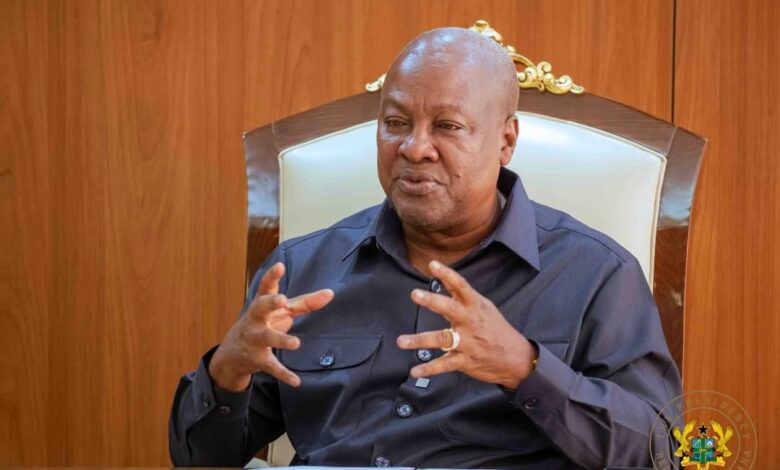
President John Dramani Mahama has reaffirmed his administration’s commitment to intensifying the fight against illegal gold mining, popularly known as galamsey, while strengthening efforts to formalize the artisanal and small-scale mining (ASM) sector.
Speaking at the Mining Local Content Summit in Takoradi, the President underscored the environmental and social cost of illegal mining, warning that economic gains cannot come at the expense of Ghana’s natural resources and community well-being.
“We’ll continue the fight against illegal gold mining and work to formalize the artisanal and small-scale mining sectors,” President Mahama declared. “We’ll increase our efforts to clean our water bodies and reclaim the lands that have been mined out.”
A Renewed Commitment
Illegal mining has severely impacted several of Ghana’s major rivers and forest reserves, raising national concern over water pollution, land degradation and loss of biodiversity.
President Mahama stressed that responsible mining must form the foundation of Ghana’s local content and industrialization agenda.
“Local content cannot be separated from responsible and community-centered mining,” he said. “Mining must leave our communities better than it found them.”
He noted that government would strengthen regulatory enforcement and deepen collaboration with traditional authorities, Metropolitan, Municipal and District Assemblies (MMDAs), and security agencies to ensure compliance with environmental standards.
“Traditional authorities and MMDAs will continue to play a decisive role in monitoring compliance and safeguarding community interests,” he added.
Formalizing Small-Scale Mining
The President acknowledged the economic importance of artisanal and small-scale mining, which provides livelihoods for thousands of Ghanaians, but emphasized the need for regulation, training and environmental safeguards.
“Our objective is not only enforcement, but reform,” he said. “We must formalize and modernize small-scale mining so that it becomes environmentally sustainable, technologically supported and economically productive.”
He explained that formalization would include licensing reforms, access to financing, training in modern mining methods and stronger environmental oversight.
Environmental Restoration
President Mahama further pledged to accelerate land reclamation and water restoration projects in mining-affected areas.
“We will intensify efforts to clean polluted water bodies and restore degraded lands,” he assured. “Economic growth must go hand in hand with environmental stewardship.”
He emphasized that sustainable mining practices are essential to protecting future generations.
“What will be the legacy of our mineral wealth 100 years from now?” he asked. “It must not be polluted rivers and abandoned pits. It must be thriving communities, restored lands and a responsible mining industry.”
Shared Responsibility
The President called on all stakeholders — miners, regulators, traditional leaders and civil society — to collaborate in safeguarding Ghana’s environment.
“This is a shared responsibility,” he said. “Government cannot do it alone. Enforcement must be consistent, transparent and fair, and every stakeholder must play their part.”