Lands Ministry Reclaims 800 Acres of Galamsey-Degraded Land at Nyankumase
Story By Michael Ofosu-Afriyie, Kumasi
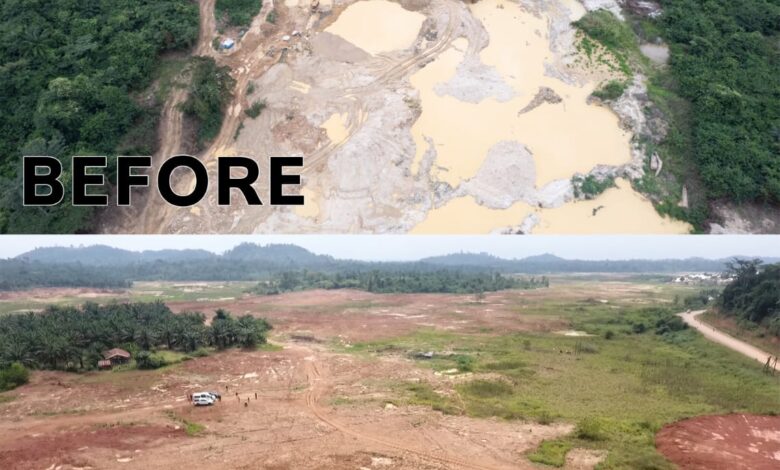
In a decisive move to address the environmental scars of illegal mining, President John Dramani Mahama has overseen the successful reclamation of 800 acres of degraded land at Nyankumase, situated in the Manso Adubia District of the Ashanti Region.
This milestone signals a robust escalation in the government’s campaign against “galamsey” and underscores a renewed commitment to large-scale ecological restoration.
Rehabilitation Initiative:
Since assuming office in 2025, President Mahama has prioritized the Galamsey Rehabilitation Initiative.
This strategic program aims to reverse decades of environmental neglect by transforming abandoned, mined-out craters into fertile landscapes suitable for agriculture and forestry.
The overarching objective is to return these lands to local communities, ensuring they transition from hazardous liabilities into viable assets for economic growth and food security.
Field Progress:
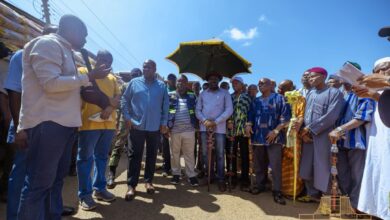
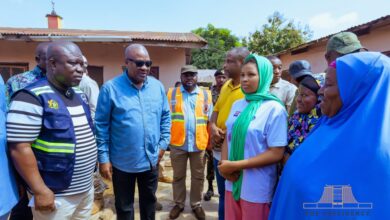
During an inspection of the Nyankumase site on Wednesday, the Minister of Lands and Natural Resources, Hon. Emmanuel Armah-Kofi Buah, detailed the government’s rigorous approach to land recovery:
Strategic Reforestation:
The 800-acre site has been replanted with Cassia and Teak trees.
These species were selected for their rapid growth, ability to stabilize depleted soil, and long-term economic value through sustainable timber harvesting.
Expert Partnerships:
The reclamation is being executed by RM Ecorestore Ghana Limited, a specialized firm partnering with the government to spearhead professional revegetation efforts nationwide.
Water Security:
Hon. Buah emphasized that land recovery is intrinsically linked to the protection of local water bodies, many of which have been severely compromised by heavy metal pollution.
Vision for Sustainability:
The Minister underscored that the Nyankumase project is a blueprint, not an isolated event.
To reinforce these efforts, the administration has introduced two complementary pillars of environmental policy:
Program Primary Objective:
Tree for Life:
Focused on aggressive reforestation to restore Ghana’s depleted forest cover.
Blue Water;
Dedicated to the purification and protection of river bodies vital for domestic and agricultural use.
“The government remains resolute. We will not relent in our duty to protect Ghana’s natural heritage,” Hon. Buah stated, noting that these projects are designed to simultaneously heal the landscape and create local employment.
Path Ahead:
While illegal mining remains a significant threat to Ghana’s rivers and livelihoods, the restoration at Nyankumase offers a tangible success story.
By evolving from mere enforcement to active ecological healing, the administration aims to prove that even the most devastated landscapes can be salvaged for the benefit of future generations.