Africa Cannot Be a ‘Jewel in a Desert of Distress’ — Mahama
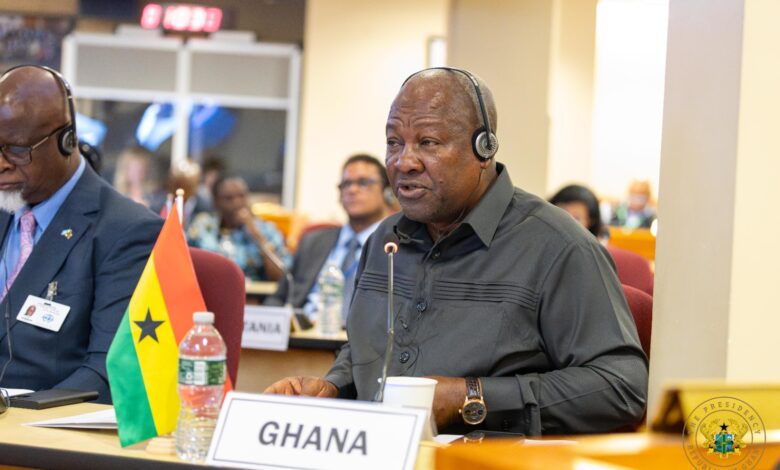
President of Ghana, H.E. John Dramani Mahama, has called for deeper African cooperation and a fundamental reset of the continent’s development model, warning that isolated national successes will not be enough in a rapidly changing global order.
Speaking at a high-level convening of the Accra Reset Initiative on the sidelines of the World Economic Forum in Davos, President Mahama said Africa must move collectively to escape cycles of dependency and underdevelopment.
“However admirable Ghana’s turnaround story is, it is not enough. We cannot be a jewel in a desert of distress. We must work together as Africa,” President Mahama said.
A Changing Global Order
The Ghanaian leader warned that the multilateral governance system established after the Second World War is weakening, with bilateral relations increasingly driven by narrow, transactional interests.
“Our world as we know it is at an inflection point. The global, multilateral governance system is breaking down, and Africa cannot afford to be passive in this moment,” he stated.
According to President Mahama, Africa must be an active participant in shaping the emerging global order rather than adapting to decisions made elsewhere.
“While no name has yet been coined for the new global system that will emerge, Africa intends to be at the table in determining what that new global order will look like,” he said.
Breaking the Dependency Cycle
President Mahama said Africa remains trapped in what he described as a “triple dependency”—reliance on external actors for security, donor funding for social services, and the export of raw materials without value addition.
“We supply the world’s critical minerals, but capture almost none of the value. This is not sovereignty; it is a trap, and it is getting worse,” he warned.
He pointed to shrinking global humanitarian assistance and shifting geopolitical priorities as evidence that Africa must urgently build internal capacity.
“Global humanitarian assistance is declining, and many countries are cutting development aid. Africa must pull itself up by its own bootstraps,” Mahama said.
Lessons from COVID-19
The President cited the COVID-19 pandemic as a defining moment that exposed Africa’s vulnerability in global systems, particularly in access to vaccines and medical supplies.
“Africa was the last continent to begin receiving vaccines during a global pandemic. That experience was a wake-up call for all of us,” he noted.
Ghana’s Turnaround, Africa’s Challenge
Highlighting Ghana’s recent economic recovery, President Mahama said disciplined leadership and accountability have helped restore macroeconomic stability.
“From a debt-distressed, crisis-ridden economy, we have achieved a strong turnaround by cutting waste, restoring confidence, and focusing on execution,” he said.
However, he stressed that sustainable progress requires a continental approach.
“No African country can industrialise on its own. We must knit together our success stories and scale them across the continent,” he added.
The Accra Reset Vision
President Mahama described the Accra Research Initiative as a practical framework for coordinated African action, focusing on skills development, regional manufacturing, and collective negotiation on minerals, trade, and climate finance.
“This is not a talk shop or another declaration. It is a practical blueprint for building real sovereignty—measured in jobs created, industries built, and young people thriving,” he said.
A Call for Partnership, Not Pity
Concluding his remarks, President Mahama called on global partners to engage Africa on the basis of mutual respect and shared interests.
“We did not come here to ask for charity. We came to propose a partnership of the willing—based on dignity, responsibility, and shared prosperity,” he said.
Looking to the future, the President framed Africa’s challenge as both urgent and hopeful.
“The question before us is not whether change is needed, but whether we have the courage to build it together,” Mahama said.