Downdraft Caused August 6 Helicopter Crash — Committee Urges Modernization of Air Force Fleet
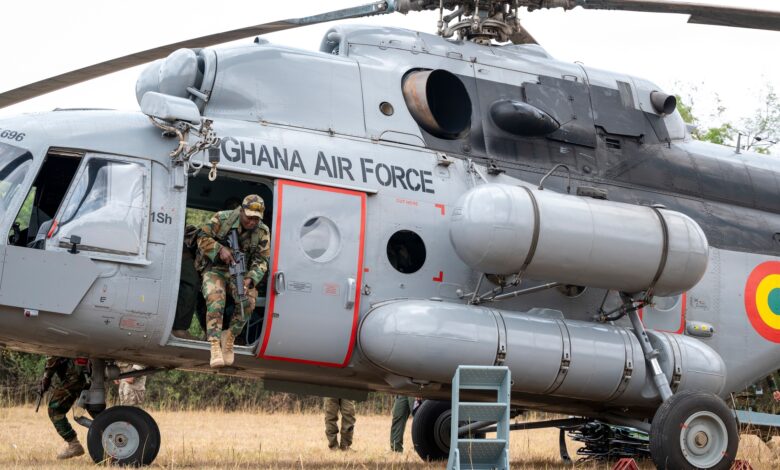
The official investigation into the August 6 military helicopter crash has concluded that the tragic incident was caused by a sudden loss of altitude due to a powerful downdraft, a weather phenomenon that occurs when cool, dense air rapidly descends, forcing an aircraft downward unexpectedly.
Presenting the committee’s findings at the Presidency today Tuesday, 11th November, 2025, Captain (Rtd) Paul Forjoe, a member of the investigative team, explained that the aircraft’s behavior before impact was consistent with the effects of a downdraft.
“The investigation determined that the accident was caused by a sudden loss of altitude to the left due to downdraft,” Captain Forjoe said. “This loss of altitude, without any change in power or pitch attitude, is consistent with the downdraft associated with changing environmental conditions over high terrain.”
The committee, chaired by National Security Coordinator COP Abdul-Razak Osman, also uncovered systemic gaps in Ghana’s military aviation infrastructure, particularly in navigation, weather monitoring, and training.
“We found that there is limited national navigational capability for en route and remote areas where there are no weather services,” Captain Forjoe noted. “We also realized that the Air Force doesn’t have much simulator training, and there’s no flight data monitoring or aircraft tracking taking place for their flights.”
He added that the absence of critical systems such as secondary surveillance radar and automatic dependent surveillance broadcast (ADS-B) meant that real-time tracking of aircraft was not possible.
Recommendations for Safety and Modernization
In its report, the committee made far-reaching safety and modernization recommendations aimed at preventing future tragedies and strengthening the operational readiness of the Ghana Air Force.
“We have recommended that the Air Force acquire modern aircraft with terrain avoidance warning systems and advanced navigation equipment,” Captain Forjoe said. “The aircraft should also have cockpit voice recorders and flight data recorders — the audiovisual-capable types.”
He further emphasized the need for sustained investment in pilot training and weather services, saying:
“The Air Force should invest in simulators for recurrent training and contract certified aviation weather providers to enhance flight safety. As a nation, Ghana must also consider establishing en route navigational aids, especially in remote areas.”
The committee additionally urged the Air Force to establish flight data monitoring and en route tracking systems, and to modernize ground support equipment to meet contemporary operational demands.
“If these measures are implemented,” Captain Forjoe concluded, “they will go a long way to improve aviation safety, enhance operational efficiency, and align Ghana’s Air Force with international standards.”
The crash, which occurred near Brofuedru in the Ashanti Region, claimed the lives of ;
Dr. Edward Omane Boamah – Minister for Defence
Dr. Alhaji Ibrahim Murtala Muhammed – Member of Parliament for Tamale Central and Minister for Environment, Science, Technology, and Innovation
Alhaji Muniru Mohammed – Acting Deputy National Security Coordinator
Dr. Samuel Sarpong – Vice Chairman of the National Democratic Congress
Samuel Aboagye – Former Parliamentary Candidate
Sergeant Leader –Peter Bafemi Anala
Flying Officer –Manin Twum-Ampadu
Sergeant -Ernest Addo Mensah