Mahama Hails GoldBod’s Profit Surge, Says Gains Must Be Built Not Borrowed
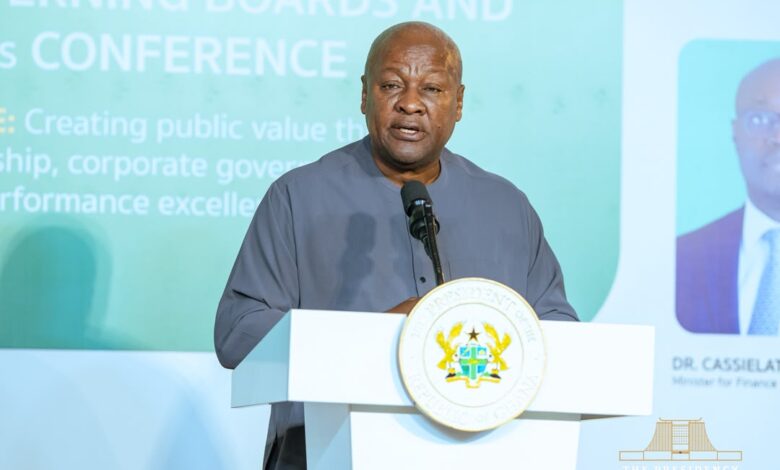
President John Dramani Mahama has framed the surge in GoldBod’s earnings not merely as corporate success, but as evidence of a deeper shift in how Ghana can protect, structure, and benefit from its own mineral wealth.
Speaking at the 2026 Governing Boards and CEOs’ Conference organised by the State Interests and Governance Authority (SIGA), the President urged Ghanaians, and especially public institutions and leaders of state-linked entities to see the numbers for what they truly represent: capacity, direction, and accountability.
At the centre of his remarks was GoldBod’s dramatic financial turnaround. President Mahama said the Board recorded a net profit of about GH¢896.5 million, a sharp rise from GH¢178.5 million in 2024. To him, the jump is meaningful precisely because it reflects institutional improvement rather than wishful thinking. “It’s not just that the profit went up,” he implied in substance; it’s that Ghana is beginning to build systems that can perform systems designed to make the gold trade transparent, accountable, and responsive to national interest.
But the President did not allow the moment to become complacent celebration. He delivered a pointed warning: a turnaround achieved in a single period cannot be treated as proof of permanence. Ghana, he cautioned, cannot afford to rely on favourable external circumstances such as exchange rate movement or temporary improvements in the business climate to mask weak foundations.
“These results deserve commendation. It must however be sustained through stronger core operations and cannot depend indefinitely on just a better business environment and the exchange rate movement. A one year turn around is encouraging but sustained performance is the real test,” he said.
That call to endurance gives GoldBod’s achievement a sharper edge. It suggests that Ghana’s reform agenda must measure success by durability, consistency, and the strength of everyday execution, and not by short-lived spikes. In that sense, the President’s message was as much about governance discipline as it was about profitability.
The audited financial picture reinforces the President’s point. GoldBod reported an operational surplus of GH¢909.7 million and an overall surplus of GH¢5.44 billion in its 2025 accounts. Revenue performance also tells a story of structural gains: non-tax revenue rose dramatically from GH¢307.7 million in 2024 to GH¢970.8 million in 2025. At the same time, the Board increased its workforce from 114 to 450, indicating that the improvement was accompanied by scaling and capacity building rather than operating on minimal inputs.
Yet, the most consequential development lies in where GoldBod found its momentum. He highlighted that the turnaround was driven by record purchases from artisanal and small-scale mining (ASM)—a segment that has long been the backbone of many mining communities, but which has often struggled with formal market access and inconsistent systems. By purchasing aggressively from ASM, GoldBod is effectively reshaping the flow of value in Ghana’s gold economy.
GoldBod purchased 104 tonnes of ASM gold in 2025, overtaking large-scale mining for the first time. Officials say this shift contributed to nearly US$11 billion in foreign exchange. And the scale has not stopped at 2025: total purchases from January 2025 to May 2026 reached 135.843 tonnes, with 98% coming from ASM. In other words, the Board is not simply buying more—it is buying in a way that brings the artisanal sector into a more organised, nationally anchored pipeline.
This is where Mahama’s remarks gain political and economic significance. By linking financial improvement to stronger structures around the gold trade, he positioned GoldBod’s performance as part of Ghana’s ability to bargain with global markets from a position of competence. The implication is clear: when governance strengthens procurement, improves oversight, and stabilises operations, Ghana’s gold does not merely leave the country—it returns as foreign exchange, national revenue, and institutional credibility.
Still, the President’s emphasis on sustained performance ensures the story does not end with applause. The real test, he suggested, is whether GoldBod can convert this momentum into a new standard—tightening core operations, sustaining improved procurement discipline, and ensuring the gains remain resilient even when external conditions change.
For now, GoldBod’s profit jump from GH¢178.5 million to GH¢896.5 million stands as a strong signal that Ghana can improve outcomes in the gold sector when accountability meets strategy. But if President Mahama’s message is to be taken seriously, the next chapter will not be about repeating a good year. It will be about building a better system that performs every year.