Mahama signs 10 Bills into law to strengthen revenue, justice and economic reforms
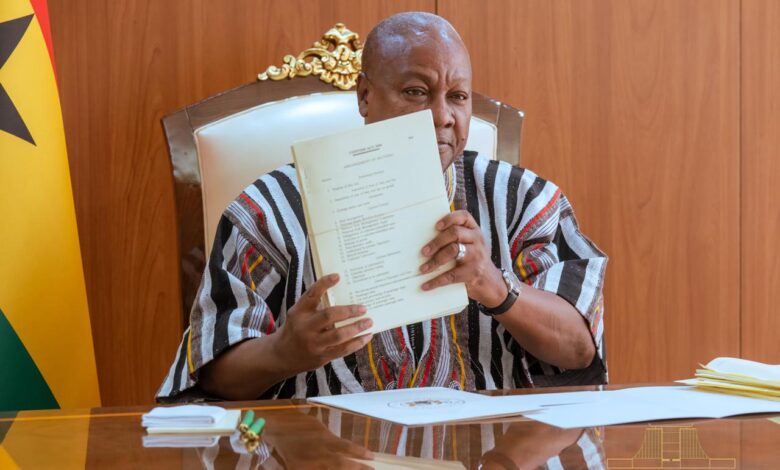
President John Dramani Mahama has signed ten Bills passed by Parliament into law, describing the measures as critical to improving revenue mobilisation, strengthening the justice system and advancing economic and institutional reforms.
The laws include the Customs Act, Community Service Act, Tribunals Act, Maritime and Related Offenses Act, National Defence University Act, Income Tax Amendment Act, Energy Sector Levies Amendment Act, Ghana Cocoa Board Act, Value Added Tax Amendment Bill and Excise Act.
Explaining the significance of the new laws, President Mahama said the Customs Act, 2026 consolidates various amendments to Ghana’s customs laws into a single legal framework.
According to him, the consolidation would make the law easier to administer, improve efficiency and help seal loopholes that have resulted in revenue losses to the state.
The President also highlighted the Community Service Act, 2026, which provides for non-custodial sentences for misdemeanours and other minor offences.
He said the legislation would reduce the need to imprison persons convicted of relatively minor offences while also reducing the financial burden on the government of maintaining prisoners.
Under the new framework, offenders could instead be sentenced to perform community service for periods determined by the courts.
On the Tribunals Act, 2026, President Mahama said the law gives effect to the constitutional provision for the establishment of regional tribunals.
He explained that the Act empowers the Chief Justice to establish regional tribunals to deal with specified categories of offences.
The Maritime and Related Offenses Act, 2026, he said, provides domestic legislation for dealing with crimes and offences committed at sea and gives effect to Ghana’s obligations under the United Nations Convention on the Law of the Sea.
President Mahama further said the National Defence University Act, 2026 provides the legal foundation for the National Defence University, making it a statutory institution and providing the basis for the accreditation of its programmes.
On taxation, the President said the Income Tax Amendment Act, 2026 exempts persons earning the national minimum wage or below from paying income tax.
He said the measure would provide relief to some of the country’s lowest-paid workers.
The Energy Sector Levies Amendment Act, 2026, meanwhile, seeks to address what the President described as longstanding loopholes involving fuel oil used by factories and maritime vessels.
He explained that users who previously benefited from exemptions would now be required to pay the applicable taxes and subsequently provide evidence of reinvestment.
According to him, the measure is intended to prevent abuse of the exemption regime and protect state revenue.
President Mahama described the Ghana Cocoa Board Act, 2026 as particularly significant for cocoa farmers, saying it incorporates reforms in the cocoa sector and gives legal backing to key government commitments.
He said the Act includes the government’s commitment to process at least 50 per cent of Ghana’s cocoa beans locally.
It also incorporates the government’s promise that cocoa farmers will receive 70 per cent of the world market price for cocoa.
“Promise made, promise fulfilled,” President Mahama said in reference to the cocoa sector commitments.
The Value Added Tax Amendment Bill, 2026, provides for adjustments to the VAT regime, including an exemption relating to gold surrendered to the Bank of Ghana by large-scale mining companies under the government’s arrangement requiring them to surrender 30 per cent of their gold to the central bank.
The President also signed the Excise Act, 2026, which consolidates previous excise laws and amendments into a single legislation.
He said the law covers products including alcoholic beverages, cigarettes and other dutiable goods while introducing measures to close loopholes responsible for revenue leakage.
Importantly, the Act provides an exemption from excise duty for locally manufactured fruit juices, which President Mahama said was intended to provide an incentive for local production.
The President said the ten new laws form part of the government’s broader efforts to strengthen Ghana’s legal and institutional framework, improve revenue mobilisation and support economic development.