GAF deploys heavy equipment to desilt Lafa basin after years of encroachment
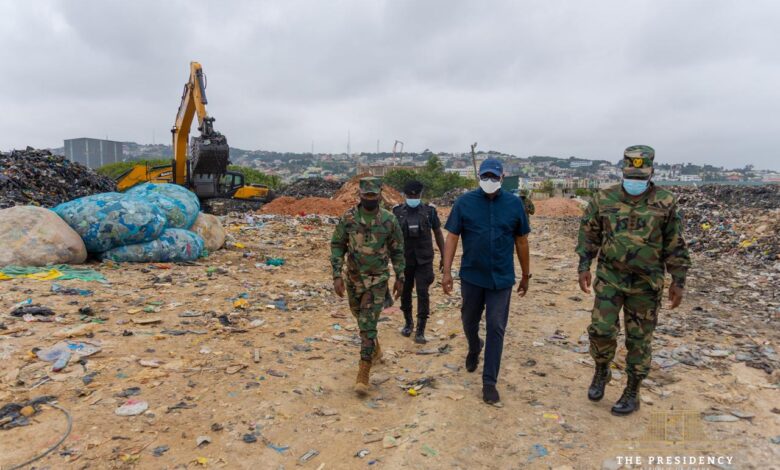
Major works have commenced to reclaim the Lafa water retention basin at Mallam as part of efforts to mitigate perennial flooding in Mallam, Weija, Dansoman and surrounding communities.
The exercise, being undertaken by the 48 Engineer Regiment of the Ghana Armed Forces under the Post-Flood Mitigation Task Force, seeks to remove years of accumulated solid waste, silt and other materials that have severely reduced the basin’s capacity to contain stormwater.
Using heavy-duty equipment, personnel are breaking up tonnes of compacted waste, dredging the basin and evacuating the debris to a designated landfill site at Nsawam.
The operation will also involve the demolition of illegal structures and buildings constructed within the water reserve, as well as the construction of protective embankments to prevent further encroachment.
The Head of Drainage at the Ghana Hydrological Authority, Ing. Richard Kofi Amekor, described the task of clearing the basin as challenging, attributing recurrent flooding along the Mallam-Gbawe and Awoshie-Kasoa highway corridor and parts of Dansoman largely to years of deliberate dumping and encroachment.
According to him, solid waste, boulders and laterite had been used to reclaim portions of the basin for illegal development, significantly reducing its natural capacity.
Ing. Amekor explained that the Lafa watercourse originates from Mallam-Gbawe Zero and passes through Santa Maria, Atieku, Pallas Town, Alhaji Tabora and McCarthy Hill before entering the basin and eventually discharging into the sea.
He said the heavy silting prevented water from flowing into the basin during the torrential rains of June 29, resulting in backwater flooding in communities including Blue Lagoon and parts of the Dansoman enclave.
“The topography in this area, with the hills upstream, obviously pushes more water into this basin, and the blockade causes the devastating floods,” he said.
Ing. Amekor expressed optimism that successful completion of the excavation would restore the basin’s natural capacity to receive large volumes of stormwater.
He, however, cautioned that the intervention may not completely eliminate flooding but would significantly reduce its impact.
He further called for the demolition of all illegal structures within the basin and urged authorities to secure the banks once the exercise is completed.
“Some buildings are within the basin, and they have reduced its capacity. All those illegal structures must go down,” he said, adding that the Hydrological Authority would work with the Weija-Gbawe Municipal Assembly to protect the reclaimed areas.
Meanwhile, the Commander of the 14 Engineer Brigade of the Ghana Armed Forces, Brigadier General Richard Kinney, said the immediate task was to loosen the compacted waste to facilitate its removal.
He explained that the waste had been dumped over several years and subsequently covered with laterite and compacted to create land for illegal sale and development.
“The main work is dredging. We are trying to loosen the waste material dumped here for years, capped with laterite and compacted to secure part of the land for sale,” Brig. Gen. Kinney said.
He disclosed that the waste would be hauled at night to the final disposal site at Nsawam.
According to him, the exercise would take several months to complete, and he urged residents and other stakeholders to stop dumping waste into the basin.
The Director General of Joint Operations at the Ghana Armed Forces and Coordinator of the Flood Mitigation Works, Brigadier General Forster Okae-Yeboah, said similar operations were ongoing at Oyarifa, East Legon and the Kpeshie Lagoon area.
He disclosed that work would begin next week at the Kpeshie enclave, particularly around Laboma Beach, to open the channel into the sea.
“Our objective is to mitigate the impact of floods in Accra, and I urge the public to cooperate with the task force,” he said.
Brig. Gen. Okae-Yeboah also disclosed that funding and equipment were available for the flood mitigation exercise following a commitment by President John Dramani Mahama.
He, however, stressed that government could not undertake the entire exercise alone and appealed to the private sector to support the initiative.
The Lafa Basin intervention forms part of broader flood mitigation measures being implemented following the devastating June 29 rains, which caused extensive damage and displacement across parts of Accra.
Authorities say the restoration of the basin, removal of illegal structures and protection of waterways will be critical to reducing the risk and severity of future flooding in the affected communities.