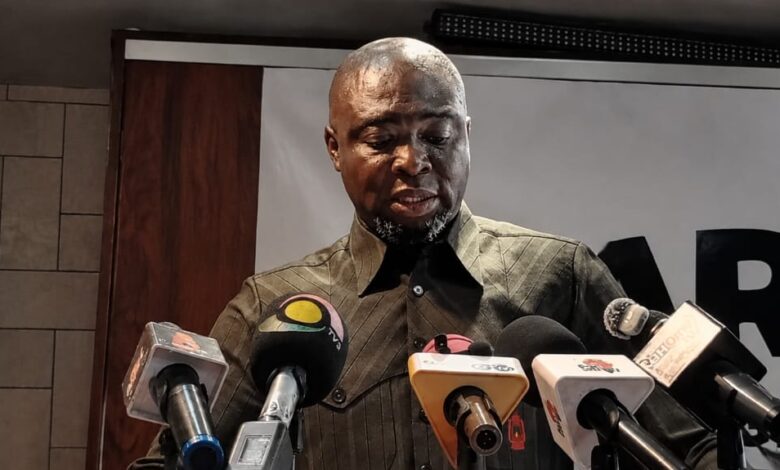
Ladies and Gentlemen of the press, Distinguished Guests, Representatives of farmer-based organizations, Civil society leaders here present, Fellow Ghanaians, Good morning!
Earlier this year, Arise Ghana engaged the media and presented findings of its independent assessment of the government’s overall performance in one (1) year in office. At that press engagement, we informed the nation that our impartial periodic assessment of the administration’s performance shall continue with the view of providing constructive feedback for improved service delivery.
In fulfillment of our promise to Ghanaians, Arise Ghana is here again with you in the second half of the year to speak to developments within key sectors of the Ghanaian economy starting with the Ministry of Food and Agriculture. Today’s press conference is hinged on the theme “Agriculture Policy Reforms: What Ghanaians must know”
Ladies and Gentlemen of the press, we believe agriculture is too important to Ghana’s economy, food security, employment and national development to be treated as a peripheral sector. The success or failure of agricultural policy directly affects what Ghanaians eat, how much they pay for food, the livelihoods of farmers, the competitiveness of local industries and the country’s dependence on imports. Yet, for years the sector continues to face challenges including limited access to affordable finance, inadequate irrigation, high production costs, weak market linkages among other challenges. Ghanaians deserve to know what is changing under the current minister of food and Agriculture, what’s working and what still needs fixing.
To us, this national conversation via the media seeks to provide an honest, non-partisan assessment of the administration’s performance in the agriculture sector with the view of highlighting key policy reforms being pursued by the government under the leadership of the Minister for Food and Agriculture, Hon. Eric Opoku, assess their potential impact on Ghana’s agricultural sector, and offer constructive recommendations to ensure that these interventions deliver sustainable benefits to farmers, consumers and the Ghanaian economy.
POLICY REFORMS UNDER FOOD AND AGRICULTURE MINISTER, HON. ERIC OPOKU, WE HAVE BECOME AWARE OF:
Ladies and gentlemen of the press, before I delve deep into the subject matter, permit me to commend the Minister for Food and Agriculture, Hon. Eric Opoku, for placing agricultural transformation prominently on the national agenda. We equally commend sector stakeholders for their constructive contributions thus far so far as agriculture policy initiatives are concerned.
Friends of the media, distinguished Comrades, ladies and gentlemen, for the purposes of this press conference, we would attempt to highlight six (6) key policy initiatives being pursued by the minister for food and agriculture under John Mahama’s reset government. The policies in no particular order of importance are indicated below;
1. Feed Ghana Programme: One of the most significant initiatives under the current agricultural policy direction is the Feed Ghana Programme, a multi-year intervention intended to increase agricultural productivity, strengthen food security, reduce dependence on food imports and create jobs. The programme represents a shift towards a more coordinated approach to agriculture, bringing together crop production, livestock, poultry, irrigation, mechanisation, extension services, farmer organisations, agro-processing and markets. One will ask, is this policy a promising one? We say yes! We consider this policy reform being implemented by the Ministry of food and agriculture as important because Ghana cannot sustainably solve its food-security challenges by focusing exclusively on the distribution of fertiliser and seeds. It’s important for the farmer to be connected to the entire value chain from land preparation and production to storage, processing, transportation and markets.
The Impact so far:
Ladies and gentlemen of the press, having independently assessed the policy, we cannot help but say, this initiative has yielded positive outcomes as follows;
-Increased access to agricultural inputs and technology: Farmers have received significant support, including 40,000 bags of inorganic fertilizer, nearly 8,000 cartons of organic fertilizer and agricultural drones to improve productivity and reduce dependence on food imports.
-Expansion of agricultural extension and farmer support: The government has trained and commissioned 506 Feed Ghana Brigadiers to provide technical support, coordinate activities at district level and strengthen extension services to farmers. This is intended to improve adoption of modern farming practices and productivity.
-Boost to food production, livelihoods and poultry development: The programme has expanded support for poultry and smallholder production. For example, 500,000 Kuroiler birds were distributed to smallholder farmers, particularly women, single mothers and persons with disabilities, with the aim of improving household nutrition and livelihoods. The poultry revitalisation programme also targets millions of birds through commercial and backyard production.
2. Seed Sovereignty & Fertilizer Reform:
Another very important policy being implemented is the Seed Sovereignty & Ferlizer Reform including the following;
– Investment in seed testing equipment, soil laboratories, and nationwide soil sampling to guide fertilizer blending.
– Rehabilitating national soil lab in Kumasi to enable district-level soil testing and end “blanket fertilizer application” to soil specific blends, with better quality control.
The Impact so far:
– Reduce dependency on imports.
– Ejapa rice seed initiative expected to yield over 10,000 tonnes of seed by 2027, making Ghana sufficient in rice seed. This supports the goal of cutting the $320 million spent yearly on rice imports.
– Food security: More reliable supply of adapted, high-yielding varieties resulting in more stable food production.
– cost reduction for farmers: By matching the right fertilizer to the right soil, farmers avoid wasting money on inputs that doesn’t work for their land.
3. Irrigation Expansion & Water Management:
We have also become aware of the effort to shift from rain-fed to irrigation-based farming for year-round production.
– Here, 10 new dams being constructed, 8 others rehabilitated, and 250 solar-powered boreholes installed.
– Major schemes like Vea, Weta, Tanoso, Ashaiman, Kpong, and Aveyime being refurbished.
– Two irrigation schemes started in Afram Plains-Kunadu to irrigate 900 hectares of land
The Impact so far:
– Ensure consistent supply for agro-processing industries.
– Reduce climate risk and increase productivity.
4. Mechanization & Farmer Service Centres:
The mechanization and farmer service centers is indeed one of the flagship agriculture policies under the reset manifesto of the NDC. The policy has;
– Procured 4,000+ units of machinery including tractors and combine harvesters.
– Establishing Farmer Services Centres nationwide – 50 centres planned for initial phase. First one cut sod at Takoratwene.
– Using DRIP equipment for farm road construction.
The Impact so far:
– Reduce reliance on manual labour.
– Improve access to machinery services for farmers.
– 1,000km of farm roads to improve market access and reduce post-harvest losses.
5. Post-Harvest & Market Systems Reform:
Under this policy reform, we have the following;
– Strengthening National Food Buffer Stock Company – NAFCO to buy surplus in peak season and release in lean season.
– Launch of locally fabricated post-harvest equipment: 300 maize and soybean threshers made by 2,231 youth artisans.
– Focus on tomato, onion, and pepper local production to cut imports.
– Rice import quota policy: importers must partner with local producers to get permits.
The Impact so far:
– Reduce the 30-40% post-harvest losses.
– Benefit 3,000+ farming families through reduced losses and higher incomes.
– Target: 100% rice self-sufficiency within 10 years.
6. Livestock & Special Crops Revival:
We cannot talk about President Mahama’s food and agriculture policies without mentioning livestock and Special crops revival. Under this policy initiative, we have the following;
– Nkoko Nketenkete Programme: Backyard poultry initiative targeting women and youth.
– “Farm to Table” framework for large/medium poultry farmers.
– YƐREDUA Vegetable Development Project: This is Greenhouse farming, irrigation-supported open fields, and nationwide vegetable nurseries for home gardening.
The Impact so far:
– Scale up domestic poultry production to reduce reliance on imported poultry.
– Improve food security and empower smallholder and subsistence farmers.
– Create sustainable jobs.
OUR ASSESSMENT OF HON. ERIC OPOKU’S LEADERSHIP:
We acknowledge that Hon. Eric Opoku assumed leadership of the Ministry at a time when Ghana’s agricultural sector requires significant structural transformation. We dare say his visionary leadership is turning things around. The intentional actions to translate policy commitments into measurable improvements in the lives of farmers, consumers and the economy is highly commendable. While at it, we believe that more must be done to institutionalise these reforms beyond individual political administrations.
Ghana has witnessed several agricultural initiatives under successive governments. The recurring challenge has been continuity, evaluation and sustainability.
The reforms currently being implemented by the honourable Minister must therefore be supported by legislation if not yet done, institutional systems, reliable financing and measurable performance indicators.
OUR RECOMMENDATIONS TO THE MINISTER:
As an interventionist civil society organisation, we respectfully call on Hon. Eric Opoku to prioritise the following:
1. Publish measurable annual targets for the major agricultural programmes.
2. Establish a transparent public monitoring system through which citizens can track programme implementation.
3. Strengthen farmer databases to reduce ghost beneficiaries and improve targeting.
4. Expand irrigation infrastructure and establish clear maintenance arrangements.
5. Improve access to affordable agricultural finance, especially for smallholder farmers and young agribusiness entrepreneurs.
6. Strengthen agricultural extension services and provide extension officers with adequate logistics.
7. Improve agricultural marketing systems to guarantee farmers reliable and profitable markets.
8. Invest heavily in storage and agro-processing to reduce post-harvest losses.
9. Give women and young people a stronger role in agricultural programmes.
10. Institutionalise agricultural reforms so that successful programmes survive changes in government.
A CALL TO GHANAIANS
We also call on Ghanaians to take a keen interest in the agricultural policies being implemented by the government.
Agriculture is not only the concern of farmers.
It affects the price of food in our markets, employment opportunities for young people, the cost of living, industrial development, imports, exports and Ghana’s overall economic stability.
Citizens must therefore demand evidence as we have done to discover the good things happening under the watch of Hon. Eric Opoku, ask questions and monitor public agricultural programmes.
At the same time, we urge stakeholders to give constructive feedback rather than politicising every agricultural intervention.
CONCLUSION:
Ladies and gentlemen of the press,
Ghana has the land, human resources, entrepreneurial talent and agricultural potential to become a major food-producing and agro-processing economy in Africa.
What we need is consistency, investment, accountability and a long-term national vision. So far, the Minister for food and agriculture is on track per our assessment of the policies he is implementing ambitiously. However, it’s equally important we emphasise that the success of his leadership will ultimately be measured not by the number of policy announcements, but by what happens on the farms, in the markets and in the homes of ordinary Ghanaians. If farmers earn better incomes, if food becomes more affordable, if young people find decent jobs in agriculture, if Ghana reduces unnecessary food imports and if agricultural production becomes more resilient and competitive, then the reforms will have delivered meaningful transformation.
Our message is therefore clear:
LET US FEED GHANA, BUT LET US ALSO MAKE FARMING PROFITABLE, AGRICULTURE COMPETITIVE AND THE FOOD SYSTEM ACCOUNTABLE.
We call on the Government, the Ministry of Food and Agriculture, Parliament, farmer organisations, private-sector actors, development partners, academia, the media and civil society to work together to build a resilient and prosperous agricultural sector.
Ghana’s agricultural transformation indeed must be a national project not a partisan project.
Thank you for coming.
For Interviews Contact Us:
0248640364-Secretary
0241384810-Leading Member
0558374179-Director of Operations