Kindergarten pupils to learn Chinese language in Ghanaian schools
The National Council for Curriculum and Assessment (NaCCA) has revised the basic school curriculum to focus on 13 subject areas designed to strengthen foundational learning while equipping pupils with 21st-century skills, values and ethics.
The revised curriculum, which covers Kindergarten to Primary Six, introduces or strengthens the teaching of Ghanaian Language, English Language, Chinese, Arabic, French, Religious and Moral Education, Mathematics, Physical Education and Health, Creative Arts, Citizenship Education, Computing, and Science with Agriculture integrated as a strand.
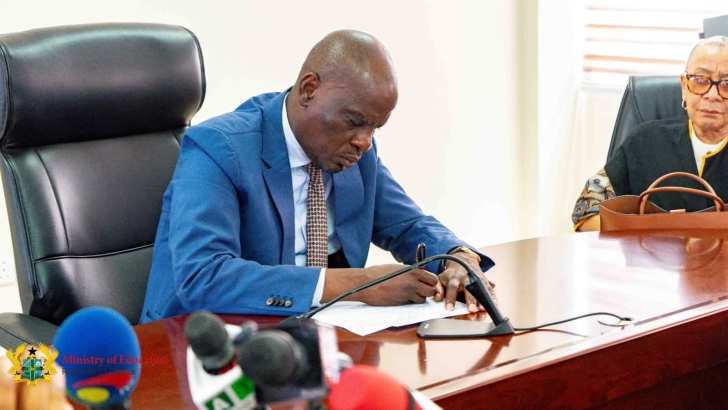
NaCCA Director-General, Professor Samuel Ofori Bekoe, presented the revised curriculum to the Minister of Education, Haruna Iddrisu, in Accra on Wednesday, July 22, 2026. He said the review was intended to address learning gaps, reduce subject overload and align basic education with emerging national priorities, in line with the government’s manifesto commitments.
Following the presentation, Mr Iddrisu directed the Ghana Education Service (GES) to complete its review of the curriculum within one week to ensure it is fully prepared for implementation and meets the required quality standards.
Professor Ofori Bekoe explained that an assessment of the existing curriculum revealed weaknesses in Mathematics, English and the teaching of Ghanaian culture and values. In response, NaCCA assembled 160 education experts and a technical working group to redesign the curriculum.
Among the major reforms is the reintroduction of Citizenship Education as a standalone subject to promote civic responsibility, history, values and ethics. Computing and Mathematics have also been expanded to include computational and quantitative thinking, exposing learners to concepts such as coding, automation and artificial intelligence.
Agriculture has been integrated into Science instead of remaining a separate subject, while classroom assessment has been redesigned to focus on task-based and formative learning, using three performance levels—basic, attained and deeper—to help teachers monitor and support learners’ progress.
The revised curriculum also introduces foreign language instruction from Primary One, replacing the previous starting point of Primary Four. Arabic has been standardised across Primary One to Six, while Chinese has been introduced as an optional language. According to Professor Ofori Bekoe, the Confucius Centre has committed to piloting Chinese in 10 schools with three teachers.
He added that ethics and values have been deliberately embedded across the curriculum to ensure they are taught and assessed alongside academic content.
Describing the curriculum reform as the most significant achievement of his tenure, Education Minister Haruna Iddrisu said his legacy should be judged by the country’s ability to produce ethical, responsible and innovative citizens.
He also announced that government had approved the use of Ghanaian languages as the medium of instruction from Kindergarten to Basic Three, with English taught as a subject during the early years to strengthen literacy and language development.
According to the minister, teaching children in their mother tongue will improve reading comprehension, cognitive development and the acquisition of English as a second language.
Mr Iddrisu welcomed the inclusion of citizenship education, ethics and cultural values in the curriculum and urged schools to prioritise assessment for learning over rote memorisation.
He further directed the GES to prioritise the recruitment of Ghanaian language teachers in its next recruitment exercise, following appeals from traditional leaders, particularly in the Greater Accra Region.
The minister also praised NaCCA for expanding access to foreign languages, including Chinese, French, Arabic, Spanish, Italian and German, saying the move would better prepare Ghanaian learners for opportunities in an increasingly globalised world.